Beef Cattle Breeds Adapter How to Say
The length of a yardstick has non inverse, but the way we use the yardstick must exist updated to more accuractly reflect electric current genetics.
I heard a seedstock breeder recently quip, "my male parent used to say, 'don't make too many convenance mistakes, because a lifetime may not exist long plenty if y'all do'." If we are not keenly aware of the rapid speed of genetic change occurring inside our selected brood(south), we may indeed exist destined to make costly convenance mistakes.
This rings especially true with beef cattle stature, every bit it is ane of the almost heritable traits nether our control. Hip height at a given historic period, converted to a 1 to x scale frame score, has been used since the 1970s to estimate the growth curve and resulting mature skeletal size of beef cattle (Figure 1). Although peak increases with age, virtually animals maintain a constant frame score during their lifetime. Frame score has assisted breeders in determining how large a replacement heifer will become as a mature cow or the projected harvest weight of feeder steers and heifers.
Today's cattle, even so, are distant relatives of the 1970s cattle that were used to develop frame score standards. A few seasoned commercial cattlemen I know recently shied away from buying bulls of less than a frame score of half dozen.5. Every bit a Michigan State Academy Extension beef specialist and MSU associate professor, I believe these cattlemen should update their use of frame score.
Seedstock breeders and their commercial customers should have a chief focus on weight. This is considering paychecks are based on weaning or carcass weight, and maintenance price is directly related to mature moo-cow weight. Traditionally, frame score has been used every bit a useful predictor of time to come weights at puberty, harvest, and maturity. However, my observation is that cattle weight to elevation ratio is irresolute fairly rapidly.
Breeders take successfully bent cattle growth curves. That is, they have sought animals that uncouple the potent positive correlations of birth, weaning, yearling, and mature weights. For generations of cattle, breeders take purposefully selected breeding stock with relatively low-cal birth weights to facilitate calving ease. At the same time, they have placed pick pressure on heavy weaning and yearling weights, to produce growthy cattle capable of a large weaning weight and quickly achieving their finished endpoint. I also doubtable that many breeders cull some of their potential replacement heifers considering they "accept too much frame," but fewer breeders cull those that are "besides heavy."
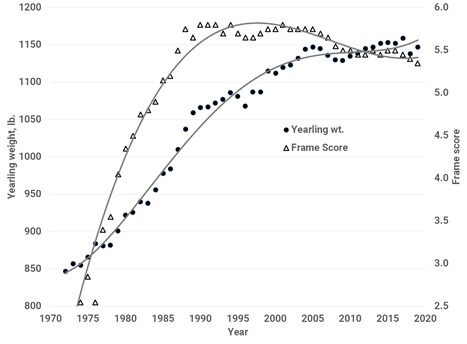
Changes in frame score and weight for bulls registered with the American Angus Clan, over the last 47 years, are graphed in Figure 2, which illustrates weight to height relationship changes. Similar to other breeds, Angus bulls during the 1970s and 1980s were being selected for increased stature. Frame scores leveled during the 1990s, and accept declined thereafter.
Interestingly, there has been a steady decline in frame score over the past 20 years that has also been accompanied past a connected increment in yearling weight. Angus cattle (every bit well as other breeds) are getting deeper and wider. We are all enamored with the "thick 1" in the pen and strive to put more muscle on the same frame. Cattle weight to height ratio is increasing based on these selection pressures. The 5.v frame score yearling Angus bull of today is 150 pounds heavier than the aforementioned frame size bull of the mid-1980s. Because weights are highly heritable, this ways daughter mature weight is also creeping upward. Indeed, Angus cow mature weights have crept up by more than 100 pounds since the mid-1980s.
What do these changes hateful for the use of frame score? Frame score is simply equally useful as it was in 1972. However, our prediction of weight at puberty, harvest, and maturity must exist adjusted upwards, at a detail frame score, based on today's cattle phenotype. Average dressed steer weights, as reported by the Livestock Marketing Data Center, have been hovering effectually 875-900 pounds in the U.S. Thus, we are already on the border of experiencing hefty discounts that almost packers impose for i,000-i,050 pounds carcass weights.
If our mindset is that selections must come from the upper end of the frame score scale, we take a chance producing discounted carcasses and cows that have a higher annual maintenance cost. In fact, the Beef Improvement Federation Guidelines now state, "predictions of expected carcass weights or mature moo-cow weights based on these frame scores that announced in many publications are likely incorrect today."
Academia needs to work on updating these weight prediction tables. In the meantime, commercial cattlemen need to visually recalibrate frame score expectations and remain focused on overall product goals. Commercial option should focus on easy calving of a vigorous bull calf, capable of fast growth until reaching an acceptable carcass weight, and a heifer gimmicky that is capable of returning to the cow herd with an acceptable mature weight and relatively depression maintenance cost.
Holding on to historic notions of frame score could lead to costly convenance mistakes.
crawfordseseely1999.blogspot.com
Source: https://www.canr.msu.edu/news/do-beef-cattle-frame-scores-need-updating
0 Response to "Beef Cattle Breeds Adapter How to Say"
Post a Comment