How to Upload Transactions Into Quickbooks Online
On the surface, importing banking concern transactions into QuickBooks Online seems piece of cake. For many users, information technology's as elementary as signing into your bank or credit carte du jour accounts through QuickBooks Online. But sometimes limitations and challenges can arise when importing transactions into QuickBooks Online.
To help you get the well-nigh from your concern bookkeeping software, this article will familiarize y'all with the QuickBooks Online Cyberbanking feature, and provide in-depth instructions for using it to import your depository financial institution transactions.
Quickbooks Online

QuickBooks Online Banking (bank feed) characteristic
Bank transactions are imported into QuickBooks Online using the Cyberbanking (or bank feed) characteristic. This feature serves two distinct purposes: reconciliation and facilitating data entry.
Reconciliation
The Cyberbanking feature provides a way to reconcile your business'due south accounting to your depository financial institution's records, virtually in real-time. There is often a 24-60 minutes lag in updates, depending on how your bank communicates with QuickBooks Online. Even with this lag, using the Banking feature to reconcile daily — or every few days — is notwithstanding quicker than the traditional reconciliation method where you lot wait for your depository financial institution or credit carte statement to arrive in the mail. This quicker reconciliation gives yous an opportunity to detect certain issues — similar an unexpected overdraft or potential fraud — much sooner than waiting until the end of the month when your bank or credit card statements get in.
Go along in mind, even though the Banking feature gives you lot the ability to compare your accounting with your bank's records daily, this quick reconciliation does not supplant the need to practise the traditional monthly reconciliation of your accounts against the statements prepared past your financial institutions. Even if your bank balance and QuickBooks amounts match when you lot are done accepting or matching transactions, it's still important to bear a complete reconciliation of your accounts each calendar month.
Data entry
Many QuickBooks Online users rely solely on the Banking feature to practise their bookkeeping. This tin result in significant errors in your books.
Using the Banking feature to import bank transactions into QuickBooks Online is a way to expedite your bookkeeping by eliminating some information entry, especially for recurring automatic transactions. However, keep in mind this is a reconciliation feature meant to compare your books with your financial institution's records.
Certain transactions — like checks yous've written, payments y'all've received from customers and asset purchases — should always be entered into your bookkeeping records when they occur and and then "matched" to the transaction in the depository financial institution feed when the transaction clears the bank. This volition foreclose mistakes in your accounting and — especially in the case of checks that oasis't cleared the bank nonetheless — will aid you keep tabs on your true available greenbacks residual.
This doesn't mean you have to go back to transmission information entry for every transaction, though. In that location are a plethora of tools — like Receipt Bank and Neb.com — that connect to and push these "lagging" transactions into QuickBooks Online for you.
The takeaway from this section: Use the Banking feature to aid you with some information entry, only resist the temptation to rely solely on imported bank transactions to do your bookkeeping.
How to import banking concern transactions into QuickBooks Online
At present allow's become down to the business of importing your depository financial institution transactions into QuickBooks Online. There are ii ways to do this:
-
Connect directly to your financial institution
-
Import from Excel
Post-obit is a step-by-footstep guide for each method.
Connect to your fiscal institution
Connecting your bank and credit carte accounts in QuickBooks Online is the quickest and most reliable way to import transactions into the Banking characteristic. It'southward also secure; your bank login information is encrypted and protected, meaning no i can access your bank accounts, even if they have access to your QuickBooks Online subscription.
ane. From the Dashboard, click on Banking.
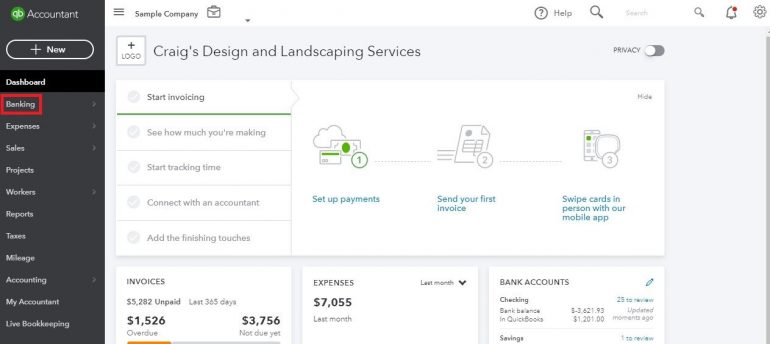
two. Click the Add Account button.

3. Enter your fiscal establishment'south name or the URL where y'all sign into your account. When you start typing the proper name of your financial institution, a listing of options will appear in a drop-down box and y'all tin select the right pick from it.
Alternatively, you can click on the logo of one of the popular banks shown on this screen.
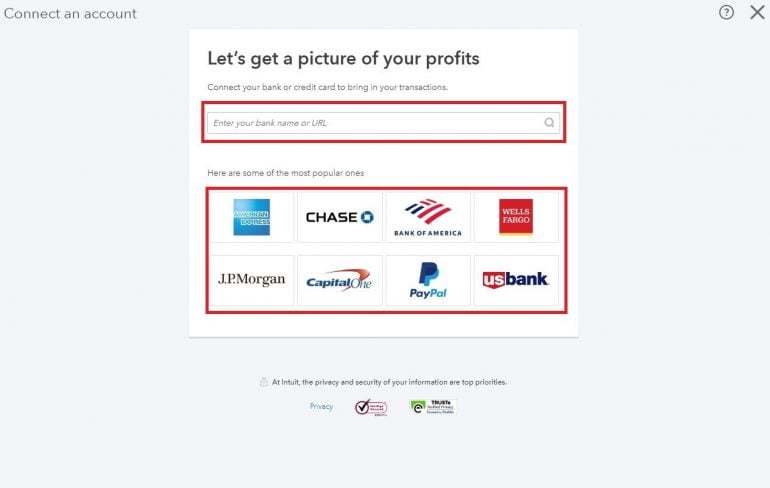
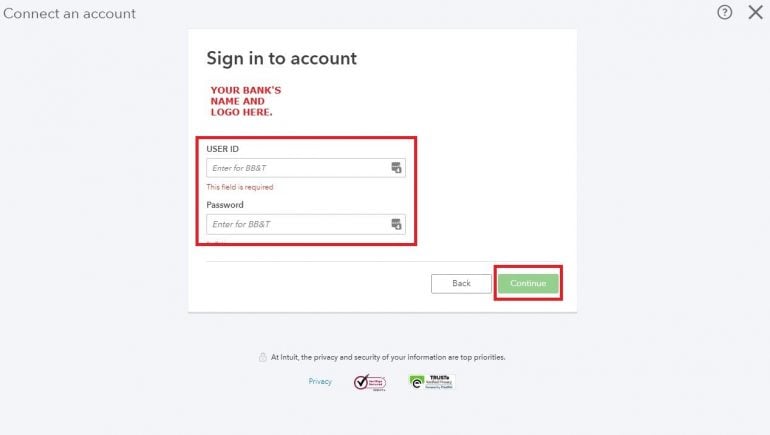
4. Enter the required data and click Continue.
5. From hither, you will get a list of accounts to connect. The current residuum in each account will exist shown (it's been redacted this on the screenshot for privacy). Select the accounts you desire to use to import transactions into QuickBooks Online. If you accept your personal accounts and your business organisation accounts at the same financial institution, make certain to merely connect your business accounts. This will keep your business and personal finances separate, which is crucial to practiced accounting.
As you select each account, you lot will exist prompted to enter the account type from a drop-down menu. Map each account you lot are importing transactions from to the corresponding bank business relationship you've currently gear up up in your chart of accounts. You can also add the bank account on the fly past clicking on "add new" at the top of the drop-down list.
Finally, select the start date you lot want to utilize to pull transactions. Notation that your bank might restrict how far back you lot can import transactions.
Once you have selected the account(s) you want to connect, click Connect.
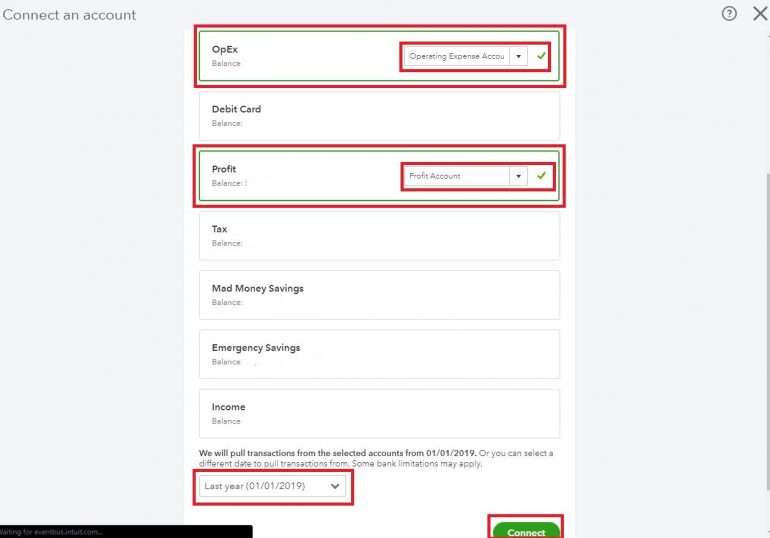
half-dozen. The bank transaction import will begin. This can be virtually instantaneous, or it can take several minutes, depending on how many transactions there are to import. Once completed, you volition exist returned to the Banking screen, where you lot tin start matching or adding the transactions that take been imported.
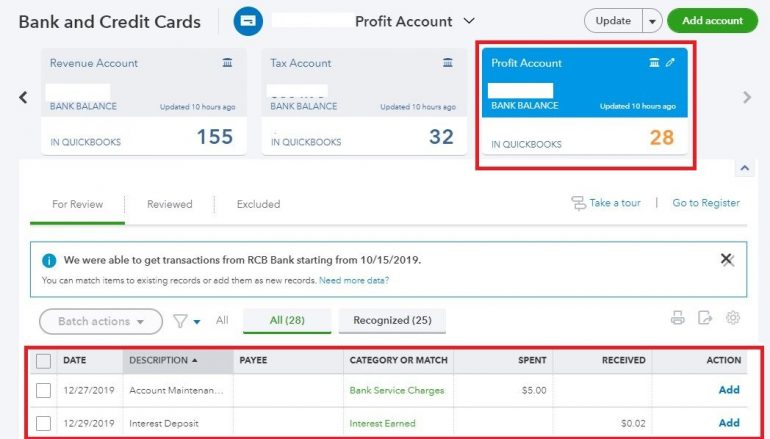
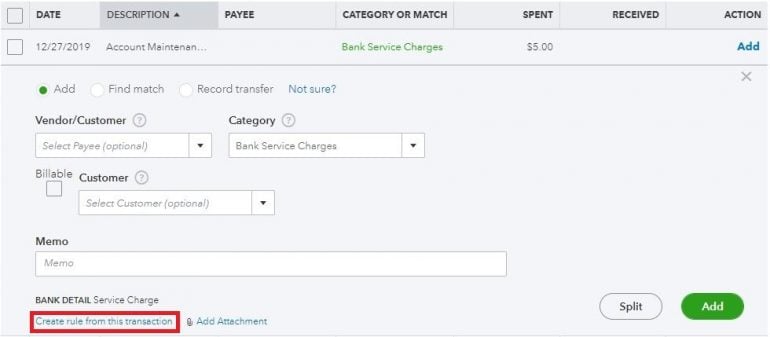
7. As yous're adding or matching your transactions, you can create rules in club to expedite this procedure moving forward. Rules are peculiarly helpful for recurring automated transactions you might non take receipts for, similar bank fees and subscriptions. Click into a transaction — in this example, we chose the "12/27/nineteen Account Maintenance" transaction — and so click "Create rule from this transaction."
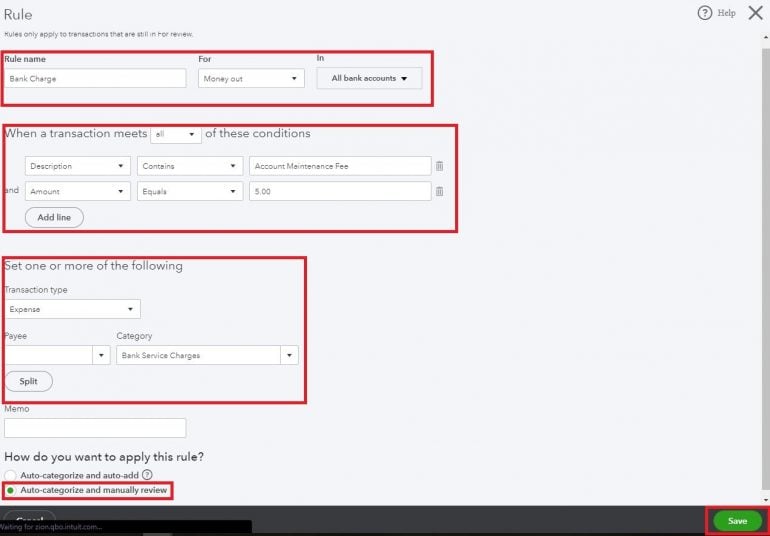
At present yous can set the conditions you want to use to apply the dominion. We recommend using the "Auto-categorize and manually review" selection so you lot still see the transaction in your bank feed, just information technology's automatically categorized based on the rule. This helps prevent misclassification errors and duplicate entries. When you are done setting the conditions, click Save to apply the rule and render to the Banking screen.
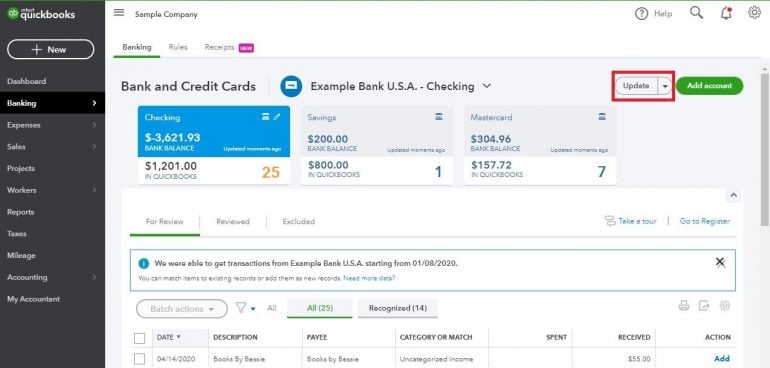
8. After the initial connexion to your financial institution, your bank transactions volition unremarkably be imported automatically every twenty-four hours. Occasionally, though, you might have to update the connection.
Start by clicking on the Update button. Requite the connections a few minutes to refresh and run across if new transactions are brought in automatically.
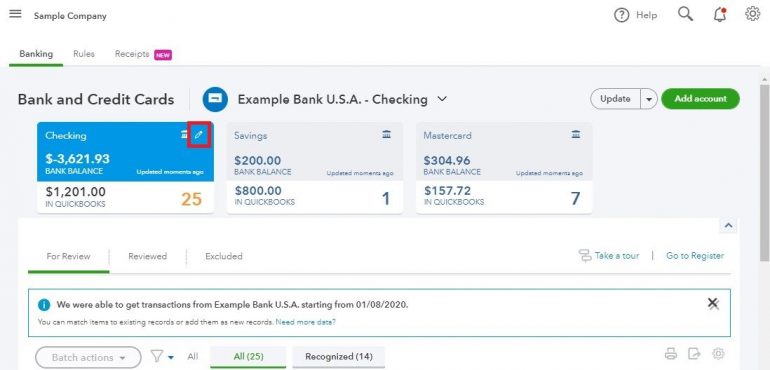
Sometimes, the bank feed volition demand to be reconnected. This typically happens when you lot change your login information with your financial institution. If this happens, click the pencil icon next to the account you need to reconnect.
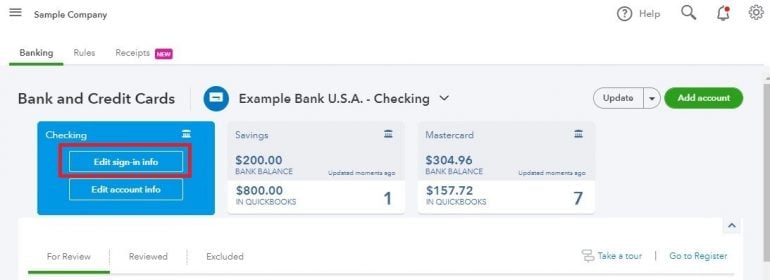
Then select "Edit sign-in info."
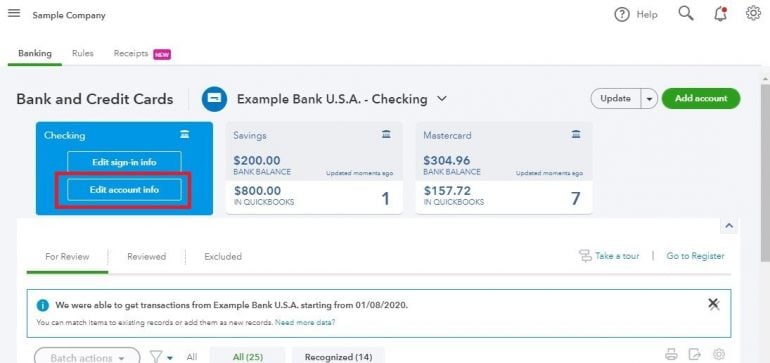
Rarely, y'all might take to disconnect the account from Banking birthday and then reconnect it. Earlier you lot continue with the next step, match or take whatever transactions currently waiting for you in the banking concern feed. Otherwise, they volition be deleted when you lot disconnect the account.
Click on "Edit business relationship info."
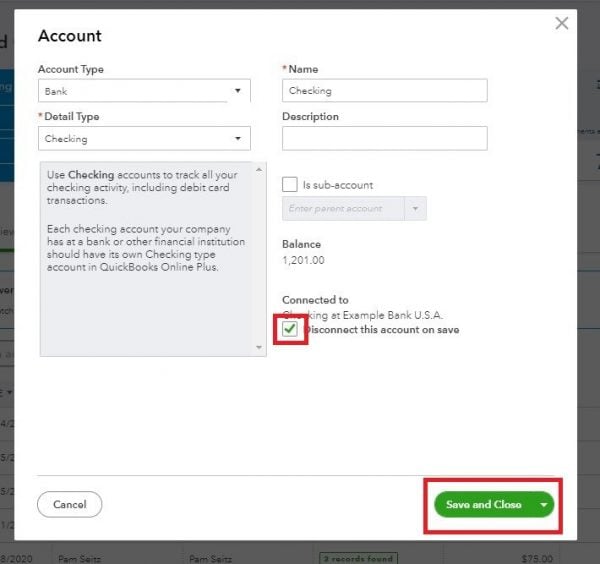
And then bank check the box next to "Disconnect this business relationship on save" and click Salve and Close.
Now follow steps i through seven above to reconnect the account.
Import transactions into QuickBooks from Excel
Sometimes, y'all might have to manually import bank transactions into QuickBooks Online. This can happen when the showtime appointment for your import is earlier than the date from which QuickBooks Online can pull transactions or — more rarely — if your financial institution does not interface with QuickBooks Online.
ane. Log into your banking company or credit card account straight and find the option to download or export transactions. You must export transactions in CSV, QFX, QuickBooks Online or OFX format. If your depository financial institution doesn't consign to 1 of these formats, look for an option to export to Excel. You can easily convert an Excel file to CSV format and use that for your import.
Every fiscal institution is dissimilar, and sometimes it's not easy to detect the choice to consign your transactions. You might take to hunt around a fleck – or contact your financial institution'southward customer service department – to find the export selection.
Many banks limit how far dorsum you can consign transactions. If you need to export transactions from further back than your depository financial institution allows, see if yous can get PDFs of your statements from the months you even so need to import into QuickBooks Online. If you can't consign all the transactions you need from your bank simply you tin get PDFs of the statements for those months, MoneyThumb has a product that will catechumen data from PDFs into a file you tin import into QuickBooks Online.
ii. If you had to consign your banking concern transactions into Excel instead of CSV, QFX, QuickBooks Online or OFX, you'll need to relieve the file as a CSV file. To do that, open the file y'all downloaded from your bank, then:
-
Click on File.
-
Click on Salvage As.
-
Choose the location where you lot want to salve the file. You can choose from the file list that appears, or you can click on Scan.
-
Change the File Name (if desired) so change "Save as type" to CSV (Comma delimited).
-
Click Save.
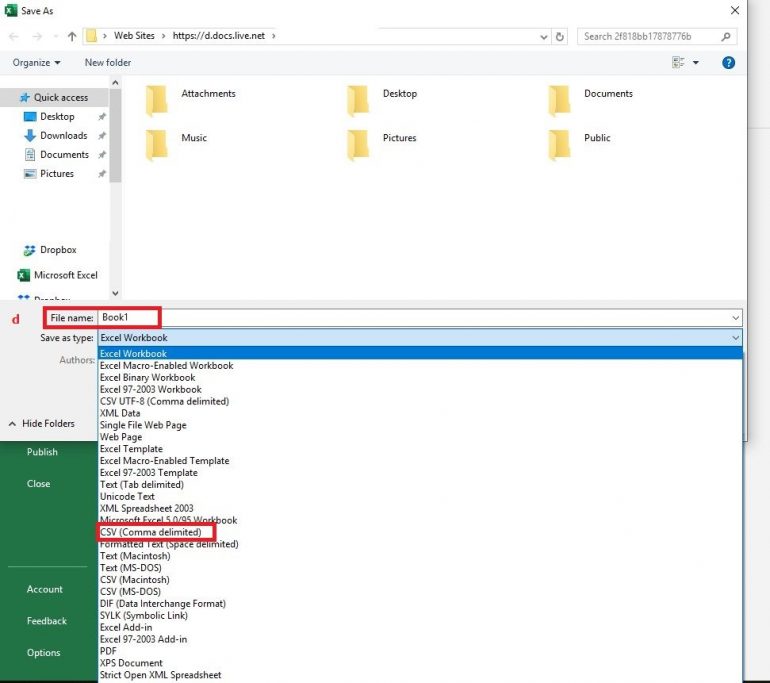
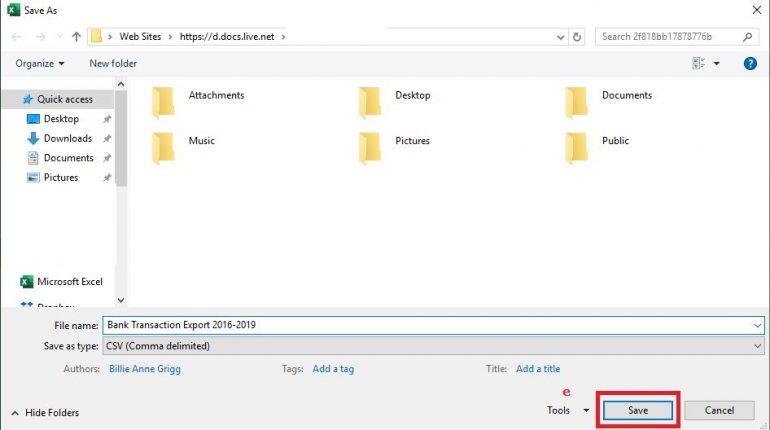
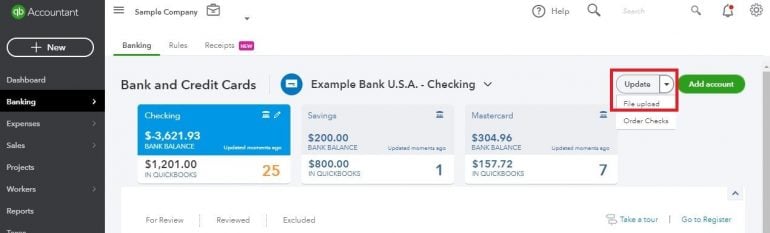
iii. Now you're ready to import your transactions into QuickBooks Online. Go to the Banking screen as in Step 1 to connect to your financial institution, but this fourth dimension y'all'll click the down arrow side by side to the Update button and choose "File upload."
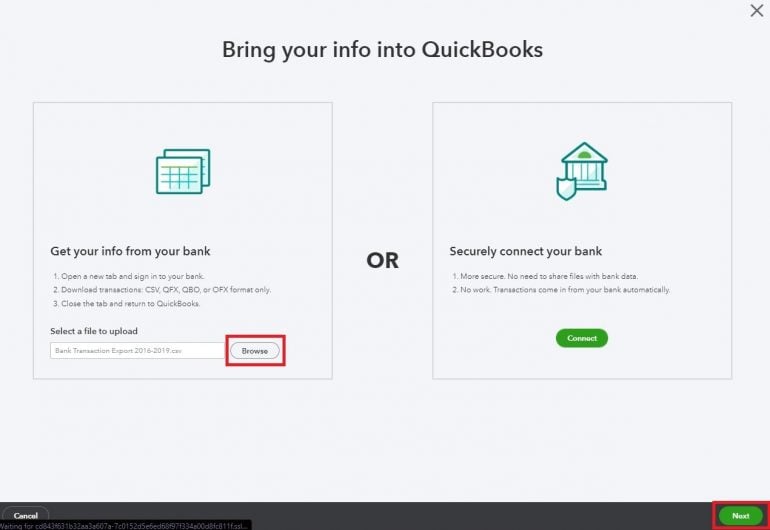
four. Click on the Browse button, find the file you want to upload, so click Next.
5. Choose the account where you want to upload the transactions, then click Next. If the bank or credit card business relationship where you are uploading the transactions doesn't already exist in your chart of accounts, you can add it by clicking "Add new" at the top of the drib-down listing.
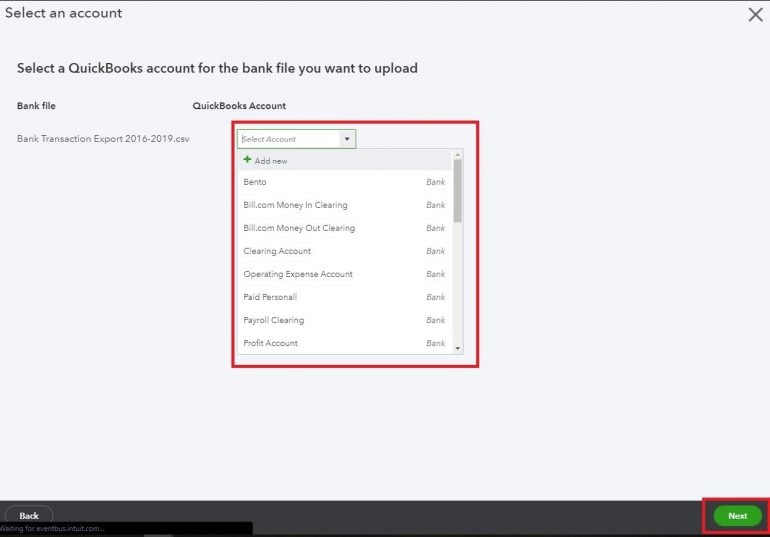
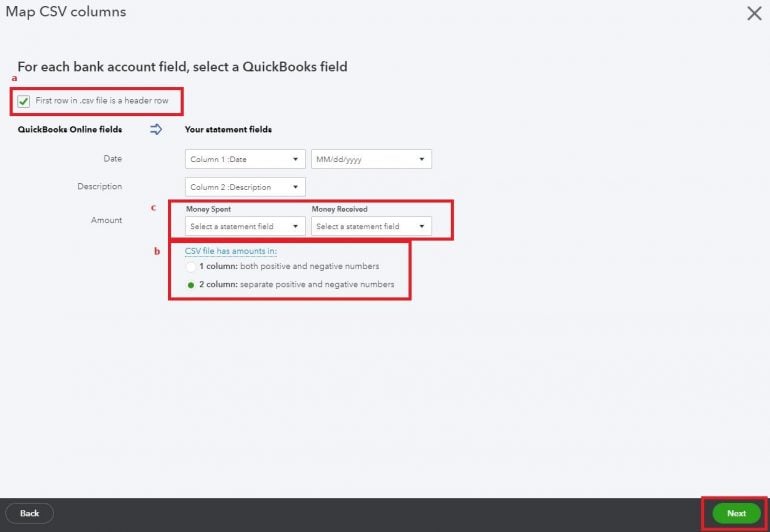
half-dozen. At present you'll demand to map the columns in your CSV to QuickBooks. Accept care hither; incorrect mapping will import your transactions incorrectly.
You lot have an choice to indicate that the start row in the CSV file is a header row (a). This will usually be the example but double-bank check your CSV to make sure in that location isn't data that needs to be imported in Row i. Y'all will as well need to indicate whether your credits and debits are in one cavalcade or ii columns (b). If your debits and credits are in separate columns, you volition need to map those columns separately (c).
When you are done mapping, click Side by side.
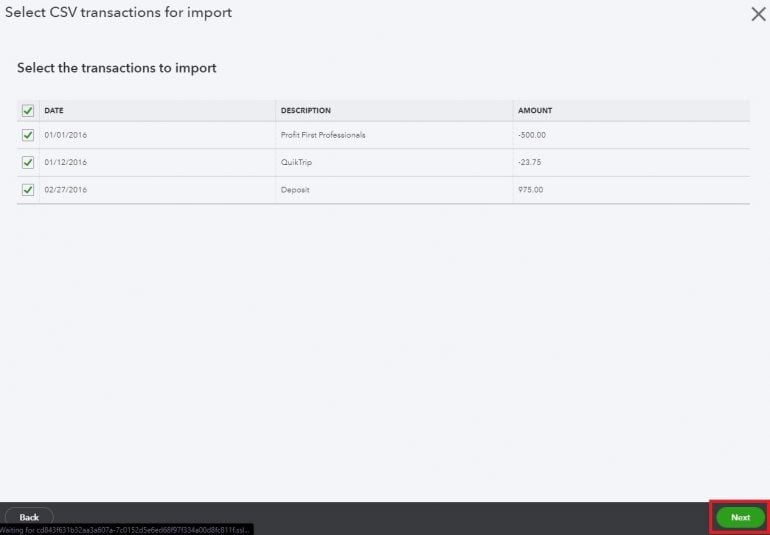
vii. The next screen will give you lot a preview of the transactions you are well-nigh to import. The QuickBooks Online default is to select all transactions, and this is what nosotros recommend unless you are certain there are duplicates in your CSV file. Make certain the data looks correct by comparison the data on this screen to the CSV you are using for the import, then click Side by side.
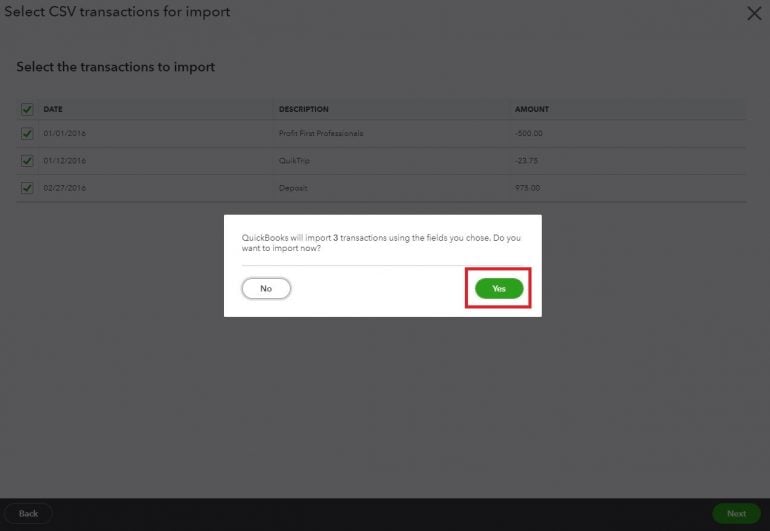
8. At present, y'all'll see a pop-up box that tells you how many transactions will be imported. Click Yes if you are ready to complete the import. If not, click No. If you click No, you will have to beginning the import process again from Footstep iii when you're gear up to proceed.
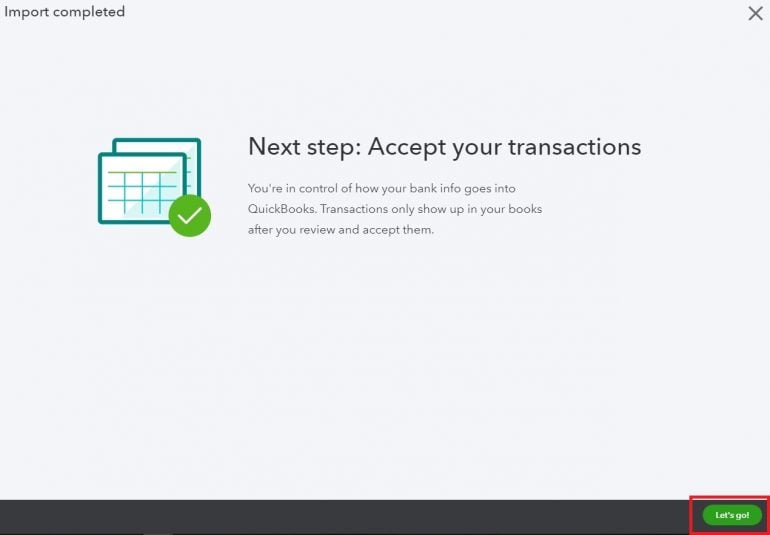
9. Once the import is consummate, y'all'll get a screen prompting y'all to have your transactions. Click "Permit's become!" to be taken to the Cyberbanking screen to start matching or calculation your transactions.
Considerations when importing transactions into QuickBooks Online
It's easy to import transactions into QuickBooks Online, but there are a few things you need to be enlightened of earlier you proceed.
Overwriting existing cyberbanking transactions
If transactions be in the Cyberbanking screen, you must take those earlier importing new transactions using the manual (from Excel) import feature. Otherwise, the existing transactions volition be overwritten in the import, and you volition accept to practice another transmission import to replace them so you can have or friction match them.
Duplicate transactions
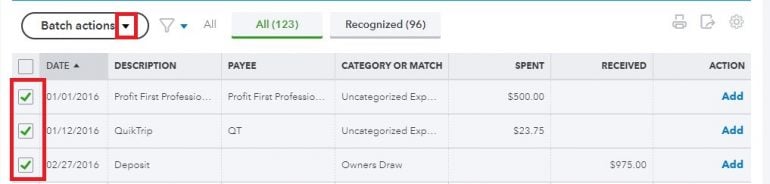
Whenever you import bank transactions into QuickBooks Online, there is a chance you could inadvertently duplicate some transactions. If you discover you lot have imported duplicate transactions, y'all tin can easily exclude the duplicates from your bank feed.
Select the indistinguishable transactions, then click the downwards arrow next to the "Batch actions" button.
Now, click on "Exclude selected."
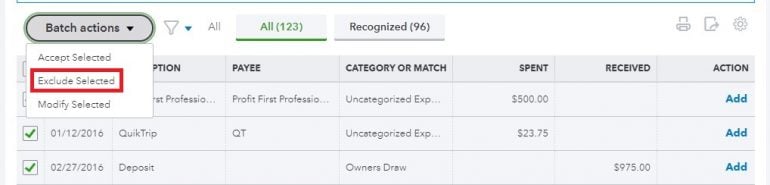
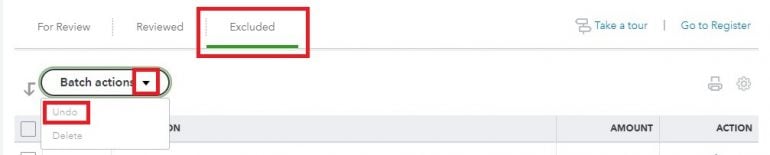
The selected transactions will be removed from your Cyberbanking screen. If you later discover they were non duplicate transactions, you lot tin can restore them by clicking on the Excluded tab, selecting the transactions you lot want to restore, and then using the "Batch deportment" button to Disengage the exclusion.
Opening balance equity
When y'all import your transactions past connecting to your financial institution, QuickBooks Online will bring in the balance on the account every bit of the first appointment of your import past making an entry to an business relationship called Opening Rest Disinterestedness. If you don't have whatever data in QuickBooks Online for the banking company or credit carte prior to the import, then this entry will have no affect on your reconciliations. In fact, information technology volition help brand your start reconciliation easier.
Nevertheless, if you accept been manually entering or importing your transactions and so you later connect to your financial institution, the Opening Balance Equity entry will touch your next banking company reconciliation.
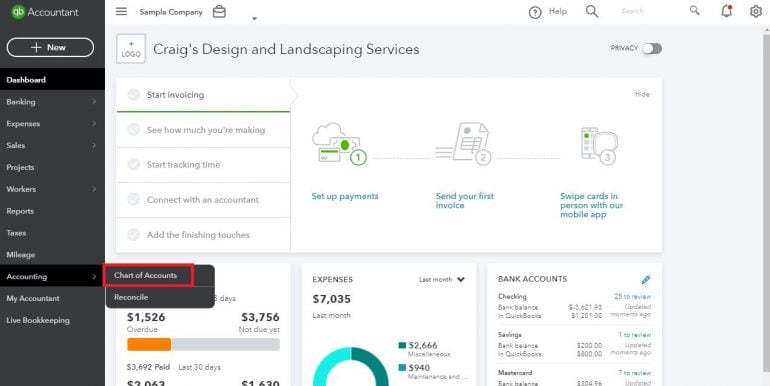
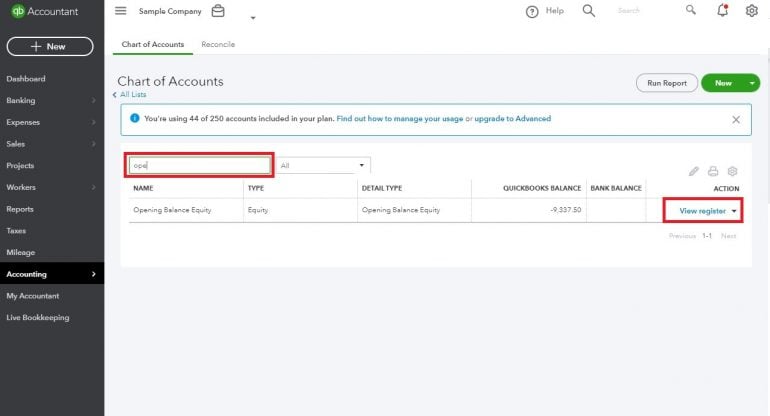
If you accept difficulty with your first reconciliation after connecting to your financial institution, go to your nautical chart of accounts and search for the Opening Remainder Equity account. Click on "View register" to encounter the transactions in the account.
Find the opening balance entry for the business relationship you are attempting to reconcile, then "unreconcile" that transaction past clicking on the "R" until that field is blank.
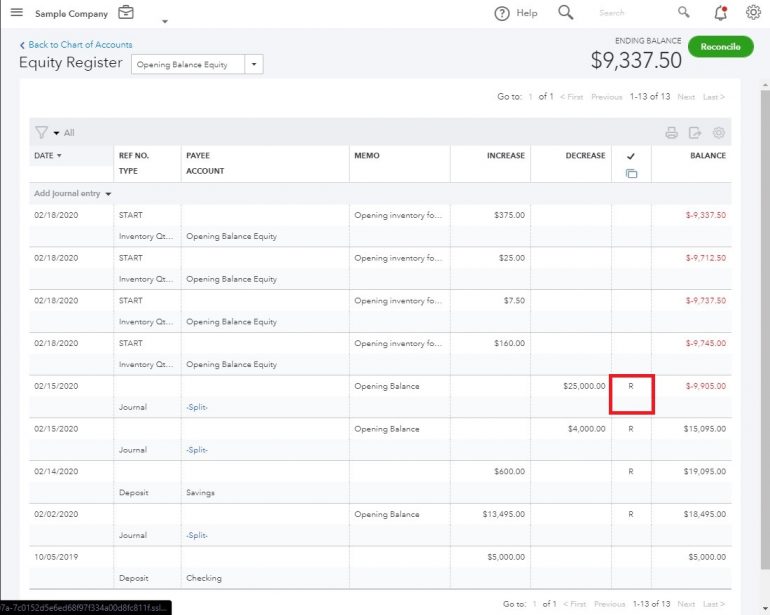
Now, return to your reconciliation and see if y'all are able to reconcile. If you can at present reconcile the account, y'all can delete the Opening Balance Equity entry for the account. If you withal have problem reconciling, though, reach out to your bookkeeper or auditor for assist.
QuickBooks Online resources
Read more almost how QuickBooks Online works.
A version of this article was first published on Fundera, a subsidiary of NerdWallet
crawfordseseely1999.blogspot.com
Source: https://www.nerdwallet.com/article/small-business/how-to-import-bank-transactions-into-quickbooks-online
0 Response to "How to Upload Transactions Into Quickbooks Online"
Post a Comment