What Are the Odds of Killing a Family Member Over a Crook With a Gun
lxx
Every month, an boilerplate of seventy women are shot and killed by an intimate partner.
Everytown analysis of CDC, National Violent Death Reporting Organisation (NVDRS), 2019.
Last updated: 1.26.2022
The Nexus Of Intimate Partner Violence And Guns
In the United States, more than than i in 3 women report experiencing abuse from a partner in their lifetime.1 Smith SG, Zhang X, Basile KC, et al. The National Intimate Partner and Sexual Violence Survey (NISVS): 2015 data brief—updated release. Centers for Disease Control and Prevention, National Centre for Injury Prevention and Command. November 2018. https://bit.ly/2DbVS9S. Intimate partner violence (IPV) is a serious public health problem that affects millions of American women, with far-reaching impacts not just for individual victims, but also for their families, their communities, and our economy. Although IPV affects people of all genders and sexual orientations, the touch of corruption, including rates of severe physical violence and violence inflicted with a firearm, is predominantly experienced by women with male partners.ii Women report lifetime IPV that resulted in a significant impact (due east.thousand. medical intendance) at a rate of 24 percent, compared to a charge per unit of 11 percent amid men. Women also study experiencing higher rates of astringent physical violence at a rate of 21 percent, compared to a rate of 15 per centum among men. Smith SG, Zhang X, Basile KC, et al. The National Intimate Partner and Sexual Violence Survey (NISVS): 2015 data brief—updated release. Centers for Disease Command and Prevention, National Center for Injury Prevention and Control. Nov 2018. https://scrap.ly/2DbVS9S. Fridel EE, Flim-flam JA. Gender differences in patterns and trends in U.s.a. homicide, 1976-2017.Violence and Gender. 2019. Guns amplify the inherent ability and control dynamics characteristic of abusive intimate relationships, whether as lethal weapons to hurt and kill or as a tool to inflict emotional abuse without ever firing a bullet.
-
What is IPV?
The terms intimate partner violence (IPV) and domestic violence are often used interchangeably. IPV can take many forms, including physical, sexual, emotional, and economic corruption, likewise as stalking by a electric current or old intimate partner.1 Breiding MJ, Basile KC, Smith SG, Black MC, Mahendra R. Intimate partner violence surveillance: uniform definitions and recommended data elements, version two.0. Centers for Disease Command and Prevention, National Eye for Injury Prevention and Command. 2015. https://bit.ly/2NDaYvQ. Intimate partner relationships include current or one-time spouses (married spouses, common-law spouses, ceremonious spousal relationship spouses, domestic partners), boyfriends/girlfriends, dating partners, and ongoing sexual partners. Intimate partners may or may non be cohabiting and can be opposite or aforementioned sex. Domestic violence is generally considered to encompass whatever abuse in the context of the dwelling or family, including kid or elder abuse. Intimate partner violence refers specifically to abuse committed by an intimate partner. Historically, IPV was referred to as domestic violence at a time when most relationships were marital and involved cohabiting partners. As the nature of intimate relationships has changed considerably in lodge, IPV is a more inclusive term to comprehend abuse in the context of varied relationships, including dating partners and partners who take a child in mutual but exercise not conjugate. Today, most international organizations and national agencies such equally the Earth Health Arrangement (WHO), Centers for Affliction Control and Prevention (CDC), and the National Plant of Justice (NIJ) utilise the term IPV.
In the US, the crisis of intimate partner violence is inextricably linked to the widespread and growing utilise of guns by abusers.
92%
92% of all women killed with guns in high-income countries in 2015 were from the US.
Grinshteyn East., & Hemenway D. "Fierce expiry rates in the US compared to those of the other high-income countries, 2015". Preventive Medicine. (2019). https://doi.org/10.1016/j.ypmed.2019.02.026
Two-thirds of intimate partner homicide in the US are killed with a gun,3 Everytown analysis of CDC, National Violent Expiry Reporting System (NVDRS), 2019. which translates to an average of 70 women shot and killed by an intimate partner every month in the US.4 Everytown analysis of CDC, National Violent Death Reporting System (NVDRS), 2019. The charge per unit of killings of women by violent partners with a firearm has accelerated in recent years. Over the x-year period between 2008 and 2017, there was a reduction in intimate partner homicides of women involving weapons—except homicides past guns, which increased by 15 pct.5 Fridel EE, Fox JA. Gender differences in patterns and trends in the Usa homicide, 1976-2017.Violence and Gender. 2019; doi: 10.1089/vio.2019.0005. Data from this study were obtained by Everytown from the writer James Alan Trick directly over email dated October 1, 2019 for this assay. Guns are also used with alarming frequency by abusers to injure victims or attempt to do then—nearly 1 million women in the US live today have reported existence shot or shot at by an intimate partner.six Sorenson SB, Schut RA. Nonfatal gun utilise in intimate partner violence: a systematic review of the literature.Trauma, Violence, & Corruption. 2018;19(4):431-442.
Intimate partner homicides of women past guns are on the rise 7 Fridel EE, Fox JA. Gender differences in patterns and trends in the U.s. homicide, 1976-2017.Violence and Gender. 2019; doi: ten.1089/vio.2019.0005. Data from this report were obtained by Everytown from the writer James Alan Play tricks direct over email dated October 1, 2019 for this analysis. The weapon category "Other" includes blunt object—hammer, club, etc.; motor vehicle; personal weapon—hands, feet, teeth, etc.; poison; pushed or thrown out the window; explosives; fire; narcotics and drugs; drowning; strangulation—choking, hanging, etc; and asphyxiation.
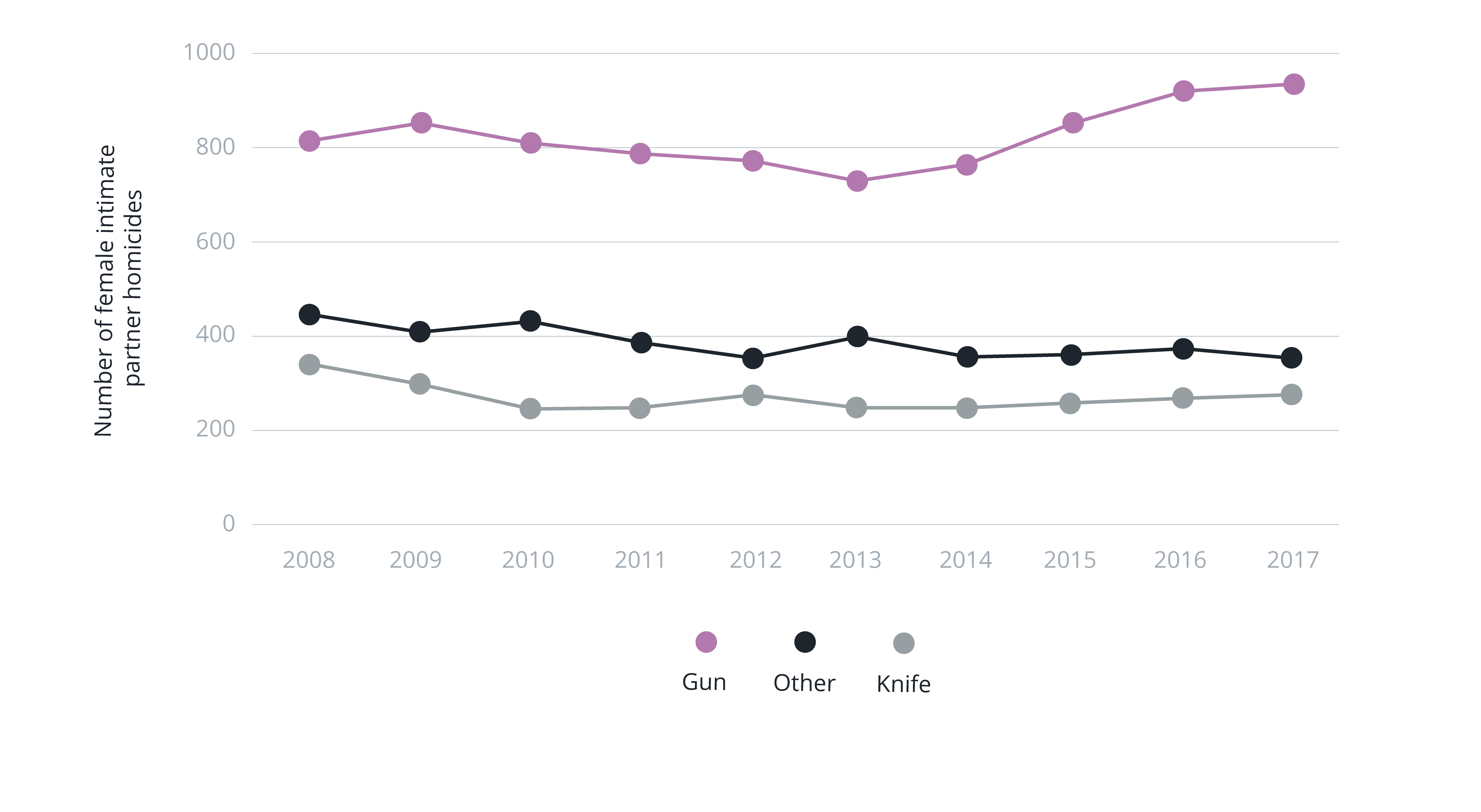
Intimate partner gun violence makes the The states uniquely unsafe for women.
When information technology comes to gun violence, the US is the most unsafe country for women among loftier-income nations. In 2015, an astounding 92 percent of all women killed with guns in these countries were from the US.viii Grinshteyn Eastward, Hemenway D. Fierce death rates in the US compared to those of the other high-income countries, 2015.Preventive Medicine. 2019;123:xx-26. This calculation is based on all gun deaths of women including gun suicides. In fact, women in the US are 28 times more likely to die by firearm homicide than women in peer nations.9 Everytown assay of the most recent year of gun deaths by land (2015 to 2019), GunPolicy.org (accessed January 7, 2022). And much of this is driven by IPV. Near one-half of female firearm homicide victims were killed by a current or erstwhile intimate partner.x Federal Bureau of Investigation. Uniform Crime Reporting Program: Supplementary Homicide Reports (SHR), 2013-2017. While the FBI SHR does not include data from Florida for the years 2013 to 2017, Everytown for Gun Safety obtained data directly from the Florida Department of Constabulary Enforcement (FDLE) and included the reported homicides in this analysis. Whereas SHR includes both current and former spouses in its relationship designations, FDLE does not include former spouses. As a result, Florida'due south intimate partner violence data includes only current spouses. Public health researchers have established that in relationships where violence is present, abusers' access to a gun significantly increases the hazard of death for women. Access to a gun makes information technology five times more likely that the abusive partner will kill his female person victim.11 Campbell JC, Webster D, Koziol-McLain J, et al. Gamble factors for femicide in abusive relationships: results from a multisite case control study.American Journal of Public Health. 2003;93(7):1089-1097.
La'Shea's Story
La'Shea was at her aunt's business firm with her children when her ex-boyfriend shot her five times and then shot himself. "He used to show up at my work and threaten me," she recalls, citing several similar incidents. La'Shea went into a coma every bit a result of the shooting merely miraculously survived. Today, the five bullets are notwithstanding within her. Her girl is now an adult, and La'Shea advocates for gun violence prevention, sharing her story to describe attention to the deadly role of guns in intimate partner violence.
This narrative was provided by La'Shea Cretain, a member of the Everytown Survivor Network.
IPV has a tragic link to mass shootings and suicide.
5x
Admission to a gun makes it five times more likely that the calumniating partner will kill his female person victim.
Campbell, J. C. et al. "Risk factors for femicide in calumniating relationships: results from a multisite case control written report". American Periodical of Public Wellness. (2003). https://doi.org/10.2105/ajph.93.vii.1089
From the 2016 Pulse nightclub massacre in Orlando, Florida, to the contempo tragedy in Dayton, Ohio, the men using firearms to inflict public terror often share histories of violence confronting women.12 Goldman A. Orlando gunman's married woman breaks silence: "I was unaware."New York Times. Nov ane, 2016. Grady C. The Dayton, Ohio, shooter reportedly kept a "rape list" of potential victims.Vox. August 5, 2019. An Everytown analysis of mass shootings—incidents in which four or more than people are shot and killed, not including the shooter—revealed that in at least 53 percent of these incidents, the perpetrator shot a electric current or former intimate partner or family member.xiii Everytown for Gun Rubber. Mass Shootings in America, https://bit.ly/3KXGno6. While research examining the connections between IPV, misogyny, and mass shootings is severely limited, analysis of recent mass shootings indicates shooters ofttimes had histories of IPV, stalking, or harassment.fourteen Folman M. Armed and misogynist: how toxic masculinity fuels mass shootings.Mother Jones. June 2019. Britzky H. Most mass shooters have a history of violence confronting women. The California shooter did too. Axios. November 9, 2018. IPV gun homicide is likewise connected with gun suicide: About two-thirds of all domestic violence–related mass shootings ended with a perpetrator dying by suicide,xv Everytown for Gun Safety. Mass Shootings in America, https://bit.ly/3KXGno6. and it is not uncommon for abusers who threaten or commit gun violence confronting their partners or children to finish up dying by firearm suicide.sixteen Fourteen pct of homicide-suicide victims are children. Logan JE, Walsh Southward, Patel Northward, Hall JE. Homicide-followed-by-suicide incidents involving child victims.American Journal of Health Beliefs. 2013;37(four):531–542.
Angela'due south Story
Angela is a mother, grandmother, old law enforcement officer, and a survivor of intimate partner violence who has lived with the fear of existence shot and killed past her ex-hubby. Her ex-hubby became abusive over fourth dimension. "I would oft be woken upwards in the center of the dark with the sound of 'spin click spin click' from a gun while it was pressed to the back of my cervix," she remembers.
This narrative was provided past Angela Wright, a member of the Everytown Survivor Network.
Abusers employ guns to threaten and control their victims, and threats often escalate to lethal violence.
It is widely known that guns are exploited by abusers to exert power and control over their partners.17 Sorenson SB, Schut RA. Nonfatal gun use in intimate partner violence: a systematic review of the literature.Trauma, Violence, & Abuse. 2018;19(4):431-442. About four.5 million women in the US today report having been threatened with a gun past an intimate partner.18 Ibid. In a 2018 survey of victim calls to the National Domestic Violence Hotline, over one-tertiary of callers reported being threatened with a gun, and over three-fourths of those who experienced such threats reported their partner also stalked them.nineteen Logan TK, Lynch KR. Dangerous liaisons: examining the connection of stalking and gun threats among partner abuse victims.Violence and Victims. 2018; 33(3): 399-416. Stalking is a predictor of lethality in intimate partner relationships: 1 study institute that 76 percentage of intimate partner homicides and 85 percent of attempted homicides of women were preceded by at to the lowest degree 1 incident of stalking in the year before the attack.xx MacFarlane JM, Campbell JC, Wilt Southward, et al. Stalking and intimate partner femicide.Homicide Studies. 1999;three(iv):300-316.
iv.5M
4.5 million women have reported being threatened with a gun by an intimate partner.
Sorenson, S. B., & Schut, R. A. "Nonfatal Gun Utilize in Intimate Partner Violence: A Systematic Review of the Literature". Trauma, Violence & Abuse. (2018). https://doi.org/10.1177/1524838016668589
Indeed, many abusers follow a common pattern of predetermined threats confronting and intimidation of their partners, even explicitly telling victims that a gun volition be used against them. For this reason, police force enforcement officials and victim advocates have learned to recognize the use of a gun by an abuser to threaten or intimidate their partner as a key predictor for intimate partner homicides.21 Campbell JC, Webster D, Koziol-McLain J, et al. Risk factors for femicide in abusive relationships: results from a multisite case command study.American Journal of Public Health. 2003;93(seven):1089-1097; Nicolaidis C, Curry MA, Ulrich Y, et al. Could we take known? A qualitative analysis of information from women who survived an attempted homicide past an intimate partner.Journal of Full general Internal Medicine. 2003;18(10):788-794
Fifty-fifty when abusers do not ultimately pull the trigger, the abuser'south use of and access to a firearm creates psychological terror for the victim. One study establish that women who had been threatened with a gun past their abuser or feared i would be used confronting them suffered more severe PTSD symptoms than those who had not endured threats with a gun.22 Sullivan, TP, Weiss NH. Is firearm threat in intimate relationships associated with posttraumatic stress disorder symptoms amidst women?Violence and Gender. 2017;four(two):31-36. According to the written report writer, "the fear of a firearm threat—just the fear of the threat, non even the actual threat—is significantly associated with PTSD. It's stronger even than the link between physical or sexual abuse and PTSD."23 Mascia J. No shots fired.The Trace. September 12, 2018.
Arming victims with guns increases their chance.
The claim that intimate partner homicide tin can be prevented by arming victims with firearms is a harmful lark from what we knowactually works to protect women from gun violence. There is no enquiry to support the idea that women's gun buying increases their rubber, regardless of whether they are IPV victims. In fact, studies show the opposite—that women living in households with a firearm are at greater risk of homicide.24 Anglemyer A, Horvath T, Rutherford Yard. The accessibility of firearms and take chances for suicide and homicide victimization among household members: a systematic review and meta-analysis.Annals of Internal Medicine. 2014;160(two):101-110. An analysis of hazard factors for women killed by their partners found that even those who live autonomously from their abuser saw no protective impact of owning a gun. Campbell JC, Webster D, Koziol-McLain J, et al. Risk factors for femicide in abusive relationships: results from a multisite case control study.American Periodical of Public Health. 2003;93(7):1089-1097. A written report of female intimate partner homicide risk factors constitute that fifty-fifty for women who lived apart from their abuser, there was no evidence of protective impact from owning a gun.25 Campbell JC, Webster D, Koziol-McLain J, et al. Risk factors for femicide in abusive relationships: results from a multisite case command written report.American Periodical of Public Health. 2003;93(7):1089-1097.And a California study found that women who purchased a gun died by firearm homicide at twice the rate of women who did non.26 Wintemute GJ, Parham CA, Beaumont JJ, Wright M, Drake C. Mortality among recent purchasers of handguns.New England Journal of Medicine. 1999;341(21):1583-1589. New research reinforces the inverse relationship between IPV victim safety and gun ownership. States with the highest rates of firearm ownership (i.eastward., the top quartile of states) have a 65 percent higher rate of IPV firearm homicide than states with the lowest rates of gun ownership (i.e., the lowest quartile).27 Kivisto AJ, Magee LA, Phalen PL, Ray BR. Firearm ownership and domestic versus nondomestic homicide in the Usa.American Journal of Preventive Medicine. 2019;57(iii):311-320. Therefore, advocating for women to be armed with guns blatantly ignores what researchers, survivors, and law enforcement know also well: Access to a firearm is associated with an increased hazard of IPV homicide, and disrupting that access reduces the likelihood of IPV condign deadly.28 Zeoli AM, McCourt A, Buggs S, Frattaroli Due south, Lilley D, Webster DW. Analysis of the force of legal firearms restrictions for perpetrators of domestic violence and their associations with intimate partner homicide.American Journal of Epidemiology. 2018; 187(11): 2365-2371. Díez C, Kurland RP, Rothman EF, et al. Country intimate partner violence—related firearm laws and intimate partner homicide rates in the United States, 1991 to 2015.Annals of Internal Medicine. 2017;167(8):536-543.
States with the highest rates of firearm ownership have a 65% higher rate of IPV firearm homicide than states with the lowest rates of gun ownership.
Abusers with guns not only impale their partners, but too often also take the lives of family unit, friends, coworkers, and responding police force enforcement officers.
3 in four
Well-nigh 3 in iv children and teens killed in mass shootings died in an incident connected to domestic violence.
Everytown for Gun Safety. "Mass Shootings in America 2009-2020". Everytown for Gun Safety. (2021). https://bit.ly/3fQBlc2
The bear on of IPV with guns extends beyond the intimate partner relationship, significantly impacting others, peculiarly children. A written report of intimate partner homicides in 16 states found that i in five victims were family members (including children), friends, persons who intervened, offset responders, and strangers. In roughly 70 percent of these deaths, the perpetrator used a firearm.29 Smith SG, Fowler KA, Niolon PH. Intimate partner homicide and corollary victims in 16 states: National Violent Death Reporting Organisation, 2003–2009.American Journal of Public Wellness. 2014;104(3):461-466. Information technology is widely known among law enforcement officers that IPV incidents (domestic disturbance calls) are the most dangerous assignments they take on the job, in large part due to abusers' use of guns.30 Calls related to domestic disputes and domestic-related incidents represented the highest number of fatal types of calls for service. Breul N, Keith, M. Deadly calls and fatal encounters: assay of US law enforcement line of duty deaths when officers responded to dispatched calls for service and conducted enforcement (2010–2014). National Constabulary Enforcement Officers Memorial Fund. 2016. Ninety-five percent of police force enforcement officeholder deaths in response to domestic disturbances between 1996 and 2010 were from a firearm. Kercher C, Swedler DI, Pollack KM, Webster DW. Homicides of law enforcement officers responding to domestic disturbance calls.Injury Prevention. 2013;19(5):331-335.
Hollie'due south Story
Hollie dropped off her two½-year-old son, Michael, for a supervised visit with her ex-hubby on March 23, 2013, in Petersburg, Pennsylvania. Hollie survived being shot in the legs and confront by her ex, but he killed Michael before fatally shooting himself. Hollie had a restraining guild against him, which prohibited him from possessing a firearm, simply he was non required to surrender his gun. "The arrangement failed my son again and again: when the gauge decided non to extend my ex-hubby's hospitalization; when he was arrested and quickly released for violating the protection from corruption order twice; when he was allowed visitations to our son; when his firearms were not made inaccessible…. I couldn't protect Michael from the organisation that failed him, but I can try to protect others whose lives are nevertheless at stake. Every bit Americans, we need to reevaluate the system that puts thousands of lives at gamble every day. My son was just 2½ years former when his life was stolen. We need to exercise more than to protect those who cannot protect themselves."
This narrative was provided by Hollie Ayers, a fellow member of the Everytown Survivor Network.
Children's exposure to IPV gun violence is permanently damaging, if not deadly.
Children are particularly affected past IPV with guns. For children nether age 13 who are victims of gun homicide, nearly one-third are connected to intimate partner or family violence.31 Fowler KA, Dahlberg LL, Haileyesus T, Gutierrez C, Bacon S. Babyhood firearm injuries in the Usa.Pediatrics. 2017;140(1). Between 2009 and 2020, nearly iii in 4 children and teens killed in mass shootings died in an incidence connected to domestic violence.32 Everytown for Gun Safety. Mass Shootings in America, https://fleck.ly/3KXGno6. Data drawn from 16 states betoken that nearly ii-thirds of child fatalities involving domestic violence were caused by guns.33 Adhia A, Austin SB, Fitzmaurice GM, Hemenway D. The role of intimate partner violence in homicides of children aged 2-fourteen years.American Periodical of Preventive Medicine. 2019;56(1):38-46.
2/iii
Information drawn from xvi states indicates that virtually ii thirds of child fatalities involving domestic violence were caused by guns.
Adhia A., Austin S., Fitzmaurice Grand., & Hemenway D. "The Role of Intimate Partner Violence in Homicides of Children Aged ii–14 Years". American Journal of Preventive Medicine, (2019). https://doi.org/ten.1016/j.amepre.2018.08.028
At that place is also ample evidence that children who survive and witness the death of their parent from IPV suffer life-altering consequences, including severe PTSD, behavioral problems, and suicidal thoughts.34 Hardesty JL, Campbell JC, McFarlane JM, Lewandowski LA. How children and their caregivers adjust after intimate partner femicide.Journal of Family Issues. 2008;29(i):100-124.These impacts significantly disrupt children's school operation,35 Alisic E, Krishna RN, Groot A, Frederick JW. Children'southward mental health and well-being after parental intimate partner homicide: a systematic review.Clinical Kid and Family Psychology Review. 2015;18(iv):328-345. and the trauma tin can follow them into machismo.36 Lysell H, Dahlin Thou, Långström North, Lichtenstein P, Runeson B. Killing the mother of i'south child: psychiatric risk factors among male perpetrators and offspring wellness consequences.Journal of Clinical Psychiatry. 2016;77(iii):342-347. Tragically, children can also be caught in the crosshairs of dangerous relationship violence when courts mandate continued contact with their abusive parent.
People of all races and ethnicities experience IPV, simply the brunt of relationship violence, including with firearms, is non shared equally by all women.37 The burden of IPV is not shared equally across all groups; many racial/ethnic and sexual minority groups are unduly affected by IPV. Niolon PH, Kearns Thousand, Dills J ,et al. Preventing intimate partner violence beyond the lifespan: a technical package of programs, policies, and practices. Centers for Disease Control and Prevention, National Centre for Injury Prevention and Command, Division of Violence Prevention. 2017. Women from communities with histories of racial discrimination, often intertwined with higher poverty rates, accept less access to protective services that reduce the take chances of lethal violence.38 Factors that put individuals at risk for perpetrating IPV include (just are non limited to) demographic factors such equally age (boyhood and young adulthood), low income, low educational attainment, and unemployment; childhood history factors such equally exposure to violence betwixt parents, experiencing poor parenting, and experiencing child abuse and neglect, including sexual violence. Ibid. Poverty is a community-level risk cistron for IPV that often, but non e'er, intersects with racial disparities. Victim advocates working in rural regions of the US, like Appalachia, know that women living in these areas are at higher chance for some of the most severe forms of IPV due to a lack of resources in their communities, including great distances between victims and their nearest shelter, hospital, or police force enforcement bureau: https://bit.ly/2MkPuCJ/. I study of women hospitalized in Appalachia due to IPV institute that, compared with other parts of the country, victims requiring medical attention for IPV were more than probable to place every bit white, and almost two-thirds of these patients lived in communities with the lowest annual median income quartile: https://fleck.ly/35BHViJ/. Information technology is important to understand this data in the context of loftier rates of gun buying in rural America: https://pewrsr.ch/2IVXb0k/." As seen in the tabular array below, Blackness, American Indian/Alaska Native, and Hispanic women are victims of homicide at the highest rates, and over 55 per centum of these killings are committed past an intimate partner.39 Petrosky Eastward, Blair JM, Betz CJ, et al. Racial and ethnic differences in homicides of adult women and the part of intimate partner violence–United States, 2003-2014.Morbidity and Bloodshed Weekly Report (MMWR). 2017;66(28):741–746. In more than than half of these deaths, a firearm is involved.40 Ibid. Robust research documents the structural disadvantages in non-white neighborhoods,41 Knopov A, Rothman EF, Cronin SW, et al. The role of racial residential segregation in Black-white disparities in firearm homicide at the state level in the United States, 1991-2015.Journal of the National Medical Association. 2019;110(one):62-75. Annotation that the researchers controlled for levels of poverty, home ownership, labor forcefulness participation, incarceration, educational attainment, and single-parent households among the Black population in each state and found racial residential segregation was positively associated with the Black firearm homicide rate. which lack trust in the criminal justice system, making them less likely to report abuse,42 Whitfield CT. It's Complicated: Why some Black women refuse to telephone call the police when their Blackness male partners threaten their lives.The Grio. April 10, 2019. and are injure by inadequately resourced social support such every bit schools, housing, and healthcare.43 McCall PL, Land KC, Parker KF. An empirical assessment of what we know most structural covariates of homicide rates: a return to a classic 20 years subsequently. Homicide Studies. 2010;14(3) 219-243. West CM. Battered, Black, and blueish: an overview of violence in the lives of Black women.Women & Therapy. 2014;25(3-iv):1-211. Smedley BD, Stith AY, Nelson AR, eds.Diff Treatment: Against Racial and Ethnic Disparities in Health Care. Establish of Medicine, Committee on Understanding and Eliminating Racial and Ethnic Disparities in Health Intendance. Washingtron, DC: National Academies Printing; 2003. These disparities can drive community violence, which is linked with higher rates of IPV44 Pinchevsky GM, Wright EM. The touch of neighborhoods on intimate partner violence and victimization.Trauma, Violence, & Corruption. 2012;xiii(ii):112-132. in large role because witnessing violence of any kind as a kid tin normalize abuse and increase the chances that the child experiences or inflicts violence in their adolescent and adult relationships.45 Firearms are used in the majority of IPV homicides of adolescents, and the majority of victims are girls. Adhia A, Kernic MA, Hemenway D, Vavilala MS, Rivara FP. Intimate partner homicide of adolescents.JAMA Pediatrics. 2019;173(six):571-577. Niolon PH, Kearns M, Dills et al. Preventing intimate partner violence across the lifespan: a technical package of programs, policies, and practices. Centers for Disease Control and Prevention, National Center for Injury Prevention and Control, Sectionalisation of Violence Prevention. 2017.
RACE/ ETHNICITY, HOMICIDES, AND IPV
| Black Women | American Indian/Alaska Native Women | Hispanic Women | White Women | |
|---|---|---|---|---|
| U.South Female person Population (%) | 12.4% | 0.8% | 13.2% | 68.3% |
| Females Experiencing IPV in Their Lifetime (%) | 44% | 46% | 37% | 35% |
| Female Homicide Charge per unit (Per 100,000) | four.four | iv.3 | 1.8 | 1.v |
2x
Black women are twice as probable to be fatally shot by an intimate partner compared to white women.
Petrosky E., et al. "Racial and Indigenous Differences in Homicides of Adult Women and the Office of Intimate Partner Violence — United States, 2003–2014". MMWR. Morbidity and Bloodshed Weekly Report. (2017). https://bit.ly/304mN46
Compared to non-Hispanic white women,Black women are twice as likely to be fatally shot past an intimate partner,49 Federal Bureau of Investigation. Uniform Crime Reporting Program: Supplementary Homicide Reports (SHR), 2013-2017. Analysis includes homicides involving an intimate partner and a firearm and compares the crude death rates for Blackness women (0.65 per 100,000) versus white women (0.35 per 100,000) (all ages included; Hispanic and non-Hispanic women included). While the FBI SHR does non include information from the state of Florida for the years 2013 to 2017, Everytown for Gun Safety obtained data directly from the Florida Department of Constabulary Enforcement (FDLE) and included the reported homicides in the analysis. Whereas SHR includes both current and erstwhile spouses in its relationship designations, FDLE does not include former spouses. As a result, Florida's intimate partner violence data includes simply current spouses. and younger Black women—between the ages of 18 and 34—are at the greatest risk: They are nearly 3 times more than likely to be shot and killed past an intimate partner than are white women in the same age group.50 Federal Bureau of Investigation. Uniform Crime Reporting Program: Supplementary Homicide Reports (SHR), 2013-2017. While the FBI SHR does non include data from the state of Florida for the years 2013 to 2017, Everytown for Gun Safety obtained information directly from the Florida Section of Law Enforcement (FDLE) and included the reported homicides in the analysis. Analysis includes homicides involving an intimate partner and a firearm and compares the crude death rates for Black women ages eighteen-34 (1.43 per 100,000) versus white women ages 18-34 (0.49 per 100,000) (Hispanic and non-Hispanic women included).
More one-half of American Indian/Alaskan Native Women have experienced physical violence by intimate partners in their lifetime.
The history of trauma, discrimination, and dispossession inflicted upon ethnic communities by federal policies continues to influence their wellness and well-being today, including leading to extremely high rates of IPV.51 The loftier rates of IPV among indigenous women in the US is also the result of a chronic shortage of preventive wellness and social services in Tribal lands and Alaska Native villages. Duran B, Oetzel J, Parker T, Malcoe LH, Lucero J, Jiang Y. Intimate partner violence and booze, drug, and mental disorders amidst American Indian women from Southwest Tribes in primary care.American Indian and Alaska Native Mental Health Inquiry. Colorado School of Public Wellness. Centers for American Indian and Alaska Native Health. Bachman R, Zaykowski H, Kallmyer R, Poteyeva M, Lanier C. Violence against American Indian and Alaska Native women and the criminal justice response: what is known. Unpublished grant report to the US Department of Justice. August 2008. Sarche M, Spicer P. Poverty and health disparities for American Indian and Alaska Native children: current noesis and future prospects.Register of the New York Academy of Science. 2008;1136:126-136. More than one-half ofAmerican Indian/Alaska Native women have experienced physical violence by intimate partners in their lifetime, a rate nearly twice as high as that amidst non-Hispanic white women.52 Virtually half of American Indian and Alaska Native women have as well been stalked, and two-thirds accept been victims of psychological aggression past intimate partners. Rosay AB. Violence confronting American Indian and Alaska Native women and men. US Department of Justice, National Institute of Justice. June ane, 2016. While the disproportionate rate of gender violence impacting Native communities is clear, the national epidemic of missing and murdered indigenous women and girls is not well-recorded.53 Repeat-Hawk A, Lucchesi A. Missing and Murdered Indigenous Women and Girls. Urban Indian Health Institute. November xiv, 2018. https://bit.ly/2qEfNrX. This ways tearing crimes against women in Tribal lands and Alaska Native villages are non consistently reflected in national law-breaking statistics.54 This is partly due to Tribal law enforcement's lack of access to federal offense reporting databases. Currently, only 47 out of the 573 federally recognized Tribes have been enrolled in the Justice Department's Tribal Admission Program, which provides Tribes the power to access and commutation data with the national crime information databases for both civil and criminal purposes. US Section of Justice. Department of Justice announces expansion of program to raise Tribal access to national criminal offense information databases. Baronial 2, 2018. https://bit.ly/2XMc2QO
ane/3
1 in three Hispanic women take experienced IPV in their lifetime.
CDC. "Intimate partner violence in the U.s.a.—2010". CDC. (2014). https://flake.ly/39E4BBl
Approximately one in iiiHispanic women have experienced IPV in their lifetime.55 Breiding MJ, Chen J, Black MC. Intimate partner violence in the United States—2010. Centers for Disease Control and Prevention, National Center for Injury Prevention and Command. 2014. Fear of deportation, language barriers, and cultural stigma discourage many Hispanic victims from reporting abuse, seeking assist, or filing for a protective guild.56 Messing JT, Vega S, Durfee A. Protection guild use among Latina survivors of intimate partner violence.Feminist Criminology. 2017;12(3):199-223. Sabina C, Cuevas CA, Lannen Due east. The likelihood of Latino women to seek aid in response to interpersonal victimization: an examination of individual, interpersonal and sociocultural influences.Psychosocial Intervention. 2014;23(2):95-103. For these reasons, this statistic is likely to be an undercount.57 Alvarez C, Fedock Chiliad. Addressing intimate partner violence with Latina women: a call for research.Trauma, Violence, & Abuse. 2018;xix(iv):488–493. While Hispanic victims of violence have long been hindered in accessing back up for abuse, recent federal policies—including the removal of immigrants by ICE officers showing upward in schools and at hearings for protective orders—have heightened the climate of fright to record levels.58 Tahirih Justice Centre, et al. May 2019 Findings: Immigrant Survivors Fearfulness Reporting Violence June 2019, available at https://scrap.ly/2IWgp5U (national survey finding that three out of four advocates and attorneys reported that immigrant survivors take concerns near going to courtroom for a matter related to the abuser/offender, and over 76 percent reported that immigrant survivors have concerns almost contacting the police).
Segments of the LGBTQ59 LGBTQ is an acronym for "lesbian, gay, bisexual, transgender, and queer" and is often used as an umbrella term to depict the community. population feel elevated rates of IPV, all the same a lack of data limits our understanding of the full scope of gun-related IPV in this customs.
Research on intimate partner homicides involving firearms amongLGBTQ people is limited due to lack of sexual orientation and gender identity data recorded on death records.60 Haas AP, Lane A, on behalf of the Working Group for Postmortem Identification of sexual orientation and gender identity. Collecting sexual orientation and gender identity data in suicide and other violent deaths: a stride towards identifying and addressing LGBT mortality disparities.LGBT Health. 2015;2(1):84-87. However, the growing body of research on this topic suggests that lesbian women, bisexual women and men, and transgender individuals study the highest rates of lifetime IPV compared to their heterosexual and cisgender61 The term "cisgender" is used to draw a not-transgender person, or someone whose gender identity aligns with the gender assigned to them at birth. counterparts.62 Lifetime rates of IPV for women are 61.1 percent for bisexual women, 43.8 percent for lesbian women, and 35.0 percent for heterosexual women. Lifetime rates of IPV for men are 26 percent for gay men, 37.3 percent for bisexual men, and 29 per centum for heterosexual men. According to a national survey past the National Centre for Transgender Equality, 54 percent of transgender adults have experienced some grade of intimate partner violence in their lifetime. Walters ML, Chen J, Breiding MJ. Centers for Disease Control and Prevention, National Center for Injury Prevention and Control. The National Intimate Partner and Sexual Violence Survey (NISVS): 2010 findings on victimization past sexual orientation. https://bit.ly/2nRCTfb. January 2013. James SE, Herman JL, Rankin S, Keisling One thousand, Mottet 50, Anafi M. The study of the 2015 United states Transgender Survey. National Center for Transgender Equality. https://bit.ly/2BXZcma. December 2016. In a contempo report on LGBTQ adults and gun violence, the Williams Institute at UCLA Schoolhouse of Law identified this every bit a significant research gap.63 Conron KJ, Goldberg SK, Flores AR, Luhur Due west, Tashman W, Romero AP. Gun violence and LGBT adults: findings from the General Social Survey and the Cooperative Congressional Election Survey. The Williams Found,%UCLA Schoolhouse of Law. https://bit.ly/2SHcgoq. November 2018.
People with disabilities are unduly impacted by corruption, but there is alarmingly fiddling research on the intersection of firearms and IPV for this population.
People with disabilities are particularly susceptible to IPV due to a variety of factors, including concrete dependence on an abuser, perceived vulnerability by abusers, and higher levels of social isolation.64 Powers LE, Hughes RB, Lund EM, Wambach Chiliad. Interpersonal violence and women with disabilities: a inquiry update. National Online Resource Heart on Violence Against Women, Applied Research Forum. September 2009. https://flake.ly/2VaXQ2D. Breiding MJ, Armour BS. The association between inability and intimate partner violence in the United States.Register of Epidemiology. 2015;25(vi):455-457. Smith DL. Inability, gender and intimate partner violence: relationships from the behavioral take chances cistron surveillance system. Sex activity Disabil. 2008;26:15–28. It is undisputed that this group is more likely to exist victims of violent crime and IPV compared to people without disabilities,65 Harrell E. U.s.. Section of Justice, Function of Justice Programs, Bureau of Justice Statistics. Criminal offense against persons with disabilities, 2009-2015–Statistical Tables. https://scrap.ly/2J4mT0F. July 2017. Breiding MJ, Armour BS. The association between inability and intimate partner violence in the United States.Annals of Epidemiology. 2015;25(half-dozen):455-457. yet what is known likely accounts for just a fraction of the true bear upon.66 Centers for Disease Control and Prevention. Sexual violence and intimate partner violence among people with disabilities. October 24, 2018. https://scrap.ly/2SynqeY. According to the CDC, prevalence data on domestic and sexual violence confronting individuals with disabilities "probable underestimate the true burden of victimization, and exclude adults living in institutions such equally prisons, group homes, and nursing homes" (settings with a high proportion of persons with disabilities). Women with disabilities are significantly more likely to experience IPV, including psychological aggression and stalking past an intimate partner, than women without disabilities67 Breiding MJ, Armour BS. The association between disability and intimate partner violence in the The states.Annals of Epidemiology. 2015;25(6):455-457.—behaviors that take been linked to increased trauma amidst victims when abusers have access to firearms.68 Sullivan TP, Weiss NH. Is firearm threat in intimate relationships associated with posttraumatic stress disorder symptoms among women?Violence and Gender. 2017;4(2):31-36.
Giovanna'southward Story
When Giovanna get-go met the homo who would one solar day hold a gun to her head, he seemed perfect. He was charming, friendly, and respected in the community. Slowly, he isolated her from her loved ones and began decision-making her every move. She was living with constant abuse. He started using a gun to intimidate her. He would threaten to shoot himself or her, sometimes in front of her ii children. Giovanna requested a protective order, and the judge granted it—but allowed her abuser to keep his weapons, leaving her and her children vulnerable.
This narrative was provided past Giovanna Rodriguez, a member of the Everytown Survivor Network.
Common-sense laws that keep guns out of the hands of calumniating partners reduce gun violence and IPV.69 Zeoli AM, McCourt A, Buggs Due south, Frattaroli S, Lilley D, Webster DW. Analysis of the strength of legal firearms restrictions for perpetrators of domestic violence and their associations with intimate partner homicide.American Journal of Epidemiology. 2018;187(11):2365-2371. Díez C, Kurland RP, Rothman EF, et al. State intimate partner violence-related firearm laws and intimate partner homicide rates in the United States, 1991 to 2015.Register of Internal Medicine. 2017;167(8):536-543. Zeoli AM, Webster DW. Effects of domestic violence policies, alcohol taxes and police staffing levels on intimate partner homicide in large US cities.Injury Prevention. 2010;xvi(two):ninety-95. However, existing loopholes in federal and state law leave guns in the easily of abusive partners and stalkers, often with deadly results. This nation's weak gun laws neglect many women across the Us each year. There are clear policies that members of Congress and state lawmakers tin enact at present to salve lives. These include:
- Strengthening land laws prohibiting domestic abusers from possessing guns and requiring abusers to relinquish guns they already have.
- Focusing on implementation and enforcement of existing state firearm relinquishment laws by land and local courts and law enforcement agencies.
- Strengthening the federal background check system to continue guns out of dangerous hands past closing deadly loopholes and addressing deficiencies including:
– The young man loophole;
– The Charleston loophole;
– The unlicensed sale loophole; and
– Improving domestic violence records. - Requiring dealers to notify state or local police enforcement when a domestic abuser or convicted stalker attempts to buy a gun and fails a background check.
- Funding comprehensive research on the nexus of guns and intimate partner violence.
States should prefer or strengthen laws prohibiting calumniating partners from possessing guns and require these abusers to relinquish their guns once they get prohibited from having them.
Over the past six years, survivors of IPV and volunteers with Moms Need Activity for Gun Sense in America take successfully advocated in 29 states and Washington, DC, to pass 51 new laws that assistance go on guns abroad from abusive partners. Despite this progress, many states do not prohibit abusers discipline to domestic violence restraining orders or abusers bedevilled of misdemeanor domestic violence crimes from possessing firearms.lxx Four states practise not prohibit abusers subject to final domestic violence restraining orders: IN, NE, SD, and VT. V states practise not prohibit abusers convicted of misdemeanor domestic violence crimes: FL, NC, NH, VA, and WI. Fifteen states do not accept either prohibitor: AK, AR, AZ, GA, ID, KY, MI, MO, MS, MT, ND, OH, OK, SC, and WY.
Even if a domestic abuser is barred by federal police force from owning a gun, without similar country police force prohibitions, land or local prosecutors do not take jurisdiction to enforce federal laws, making it less likely that abusers are prosecuted for violating the law.71 International Clan of Chiefs of Police force. Firearms policy position statement. https://bit.ly/2SIGF5D. 2018. For example, in 2018, the International Association of Chiefs of Police (IACP) released a position paper announcing its support for "the adoption of common sense policies that will assist in reducing gun violence," including an terminate to the gun-testify loophole, establishing a firearms offender registry, and greater federal resources to assist state and local police officers in firearms enforcement programs. It is therefore critical for states to adopt these laws, which are proven to be effective. States that prohibit abusers discipline to domestic violence restraining orders from possessing guns take seen a xiii pct reduction in intimate partner firearm homicide rates.72 Zeoli AM, McCourt A, Buggs S, Frattaroli S, Lilley D, Webster DW. Analysis of the strength of legal firearms restrictions for perpetrators of domestic violence and their associations with intimate partner homicide.American Journal of Epidemiology. 2018;187(11):2365-2371. The impact is fifty-fifty greater at a local level: Cities in states that prohibit firearm possession past abusers subject field to domestic violence restraining orders accept seen a 25 per centum reduction in intimate partner firearm homicide rates.73 Zeoli AM, Webster DW. Effects of domestic violence policies, alcohol taxes and police staffing levels on intimate partner homicide in big Us cities.Injury Prevention. 2010;16(two):ninety-95.
Congress and the states should also ensure that calumniating partners actually relinquish their firearms when they become prohibited from possessing them.74 Currently, twenty states (CA, CO, CT, HI, IA, IL, LA, MA, Md, MN, NC, NH, NJ, NM, NY, PA, RI, TN, WA, and WI) and Washington, DC, require abusers subject to final domestic violence restraining orders to turn in their guns, and sixteen states (CA, CO, CT, Hi, IA, IL, LA, MA, Dr., MN, NV, NJ, NY, PA, RI, and TN) and Washington, DC, require convicted domestic violence misdemeanants to do then. The results in states that take enacted laws that encourage or crave abusers subject to domestic violence restraining orders to relinquish their firearms speak for themselves: At that place was a 14-16 percent lower intimate partner firearm homicide rate.75 Díez C, Kurland RP, Rothman EF, et al. Land intimate partner violence-related firearm laws and intimate partner homicide rates in the United states of america, 1991 to 2015.Annals of Internal Medicine. 2017;167(eight):536-543. Zeoli AM, McCourt A, Buggs S, Frattaroli Southward, Lilley D, Webster DW. Analysis of the strength of legal firearms restrictions for perpetrators of domestic violence and their associations with intimate partner homicide.American Journal of Epidemiology. 2018;187(11):2365-2371.
Land and local courts and police force enforcement agencies should focus on implementation and enforcement of laws that require abusive partners to relinquish their guns.
Despite the higher up show of the effectiveness of laws requiring abusers to relinquish their firearms, many states have not fully implemented these laws, leaving survivors at hazard. Full application and enforcement of firearm relinquishment laws requires all parts of the justice system to contribute:
- Country and local leaders should facilitate law enforcement training most relinquishment laws and how to safely enforce them.
- Court administrators should ensure that all judges receive training about firearm prohibition and relinquishment laws and that court forms provide survivors and abusers with data about their rights and obligations.
- Judges should gild firearm relinquishment in all cases required by land police, ensure that abusers sympathise the requirement to relinquish firearms, and monitor compliance with firearm relinquishment orders.
- Land executives such equally state attorneys general and governors' offices should review court and law enforcement practices and implementation information to verify that prohibited abusers accept relinquished their firearms.
- Law enforcement agencies should develop a protocol for storage of firearms and should regularly communicate compliance and not-compliance by respondents to the courts and prosecutors.
- District attorneys should fully prosecute abusers constitute to be non-compliant or in unlawful possession of firearms.
Jurisdictions that have fully implemented these laws accept seen immediate safety improvements. For example, inMale monarch County, Washington, a regional domestic violence firearms enforcement unit of measurement staffed past law enforcement, prosecutors, and members of the City Attorney's Role works to ensure that defendants field of study to a domestic violence protective order relinquish their firearms. The issue: The squad more than quadrupled the number of firearms recovered in domestic violence cases in the region in 2018, as compared to 2016.76 The states Government Accountability Role. Report to the Acting Ranking Member, Subcommittee on Commerce, Justice, Science, and Related Agencies, Commission on Appropriations, House of Representatives. Gun control: analyzing available data could help improve background checks involving domestic violence records. https://bit.ly/2CkTs94.
Jurisdictions without state-based firearm prohibition and relinquishment laws have likewise provided leadership in protecting survivors of domestic violence.77 In Dallas County, Texas, a gun surrender program pioneered by Judge Roberto Cañas created a partnership between the courts and law enforcement, enabling domestic violence offenders to safely surrender firearms to law enforcement officers when they became prohibited from possessing a firearm nether federal law. Choi L, Elki R. Harasim M. Taking aim at family unit violence: a report on the Dallas County Gun Surrender Program. Spring 2017. Local law enforcement officers in these jurisdictions should report cases where domestic abusers are found in possession of a firearm to federal prosecutors' offices for prosecution on unlawful firearms possession charges—a policy supported by the U.s.a. Department of Justice.78 Ibid.
Congress and state legislatures should strengthen the background bank check organisation by closing mortiferous loopholes and improving records that will continue guns out of the hands of people with dangerous histories, including domestic abusers.
Congress should shut the boyfriend and stalking loopholes in the federal gun prohibition laws.
Current federal law prohibits people convicted of domestic violence crimes and abusers under restraining orders from possessing guns only if the abuser has been married to, lives with, or has a child in common with the victim. Information technology does not encompass abusive dating partners.79 18 United states of americaC. § 922(g)(8), (9); 18 U.S.C. § 921(a)(32), (33). The constabulary applies to people bedevilled of domestic violence crimes and abusers under restraining orders only if the abuser has been married to, lives with, or has a kid in common with the victim. The law also covers children of abusers and of abusers' intimate partners. The exclusion of abusive dating partners from firearms restrictions is especially outdated given the irresolute nature of relationships.80 Couples are delaying marriage and the median age of first spousal relationship for women has increased from 22 in 1990 to 28 in 2018. U.S. Census Bureau Estimated median age of first marriage by sex: 1890 to the present table. November 2018. https://bit.ly/2IWPaKO This gap in the police force has go increasingly mortiferous: The share of homicides committed by dating partners has been increasing for three decades,81 Cooper Advertisement, Smith EL. Homicide trends in the U.s., 1980-2008. Us Department of Justice, Office of Justice Programs, Bureau of Justice Statistics. November 16, 2011. and now women are as probable to be killed by dating partners equally by spouses.82 Ibid. Additionally, current federal law does not prohibit people bedevilled of misdemeanor stalking crimes from having guns.83 Stalking is typically divers as repeatedly following, harassing, or cyberstalking another person. See, e.g., Fla. Stat. § 784.048. A number of states have addressed this federal loophole through policies that prohibit abusive dating partners and convicted stalkers from possessing guns.84 Xx states (CA, CT, DE, Hi, IL, IN, KS, MA, ME, Doc, MN, NE, NJ, NM, NY, OR, RI, VT, WA, and WV) and Washington, DC, have adopted laws prohibiting abusive dating partners convicted of domestic violence crimes from possessing guns. Twenty-one states (CA, CT, DE, Hello, IL, LA, MA, MD, MN, NC, NH, NJ, NM, NY, OR, PA, RI, TX, WA, WI, and WV) and DC prohibit dating partners under domestic violence restraining orders from possessing firearms. And 20 states (AZ, CA, CO, DE, Hello, IL, IN, MA, MN, MD, NJ, NM, NY, OR, PA, RI, SC, TX, VT, and WI) and DC have prohibited all convicted stalkers from possessing firearms. Inquiry shows that when states broadened their firearm prohibition laws beyond federal police force to cover abusive dating partners, the states experienced a 16 percent reduction in intimate partner firearm homicide rates.85 The report also plant the police force to exist associated with a 13 percent reduction in overall intimate partner homicide rates. Zeoli AM, McCourt A, Buggs S, Frattaroli S, Lilley D, Webster DW. Analysis of the strength of legal firearms restrictions for perpetrators of domestic violence and their associations with intimate partner homicide.American Journal of Epidemiology. 2018;187(11):2365-2371.
Congress and state legislatures should close the Charleston loophole that puts victims of IPV at heightened risk.
Federal constabulary requires that licensed gun dealers run groundwork checks on all potential gun buyers. But due to a National Rifle Association–backed provision added to the 1993 Brady Nib, the law allows sales to continue by default after three business days—even in the absence of confirmation that the buyer is legally allowed to have guns.86 This loophole is the one through which the shooter at Emanuel AME Church in Charleston, South Carolina, obtained the firearm he used in the shooting on June 17, 2015. The shooter, who was prohibited from possessing firearms due to an earlier drug arrest, was able to purchase the gun he used in the shooting because the default continue period had elapsed, and the dealer made the sale fifty-fifty though the background cheque was not complete. From 2006 to 2015, 30 percent of gun sale denials past licensed dealers to buyers convicted of misdemeanor domestic abuse took longer than three business days.87 United States Government Accountability Part. Report to the Interim Ranking Member, Subcommittee on Commerce, Justice, Scientific discipline, and Related Agencies, Commission on Appropriations, House of Representatives. Gun control: analyzing bachelor data could aid improve background checks involving domestic violence records. https://bit.ly/2CkTs94. That ways licensed dealers were legally authorized nether federal constabulary to transfer guns to eighteen,000 people who were prohibited domestic violence misdemeanants merely considering their groundwork checks took longer than three days.88 Ibid. In 2017 alone, licensed dealers sold guns to i,120 prohibited domestic abusers because a federal background bank check could not be completed within three business days. U.s. Department of Justice, Office of Justice Programs, Criminal Justice Information Services Division. National Instant Criminal Background Check Organization (NICS) operations report. https://fleck.ly/2Hu9H7j. 2017. This is likely to be an undercount since it is based on solely on background checks conducted by the FBI and does not include information from Betoken of Contact states that conduct their own background checks. Congress and country legislatures should prohibit a firearm transfer until the results of a National Instant Criminal Background Cheque System (NICS) check indicate that the buyer is not prohibited from possessing guns.89 19 states and Washington, DC, accept laws that requite authorities longer than three business days to complete a background check on potential gun buyers: CA, CO, CT, DE, FL, HI, IL, MA, Md, MN, NC, NJ, NY, PA, RI, TN, UT, WA, and WI.
States should amend the quality of domestic violence records in the groundwork bank check organization.
Bedevilled domestic abusers and subjects of domestic violence restraining orders are prohibited from having guns under federal police, but a Government Accountability Role report indicates that some courtroom records for these abusers are missing from the groundwork check organisation, and others are not identifiable as prohibiting.90 United States Government Accountability Role. Study to the Interim Ranking Member, Subcommittee on Commerce, Justice, Scientific discipline, and Related Agencies, Commission on Appropriations, Business firm of Representatives. Gun command: analyzing available data could aid better background checks involving domestic violence records. https://bit.ly/2CkTs94. July 2016. When a prohibited abuser tries to buy a gun and undergoes a NICS cheque, the sale will be stopped just if their record is in the system and contains sufficient information to identify it as prohibiting. States demand to ensure that all domestic violence criminal records and domestic violence restraining orders are entered into the NICS database in a timely manner.91 Misdemeanor crime of domestic violence (MCDV) records may be flagged through the Identification for Firearm Sales program, and domestic violence restraining club (DVRO) records may be flagged with a Brady indicator or the point-of-contact (POC) code 07. It is also of import for states to identify special flags on these records when submitting them to the system to indicate that they prohibit a person from possessing firearms under federal law. If a tape is flagged as prohibiting and the offender attempts to purchase a gun, the background check operator will see the flag and will instantly know that the sale should be denied, reducing the possibility of selling to a prohibited domestic abuser due to the Charleston loophole.
Congress and state legislatures should ensure that prohibited domestic abusers and stalkers cannot evade background checks by purchasing guns from unlicensed, private sellers.
Since the introduction of the NICS in 1998, about 400,000 firearm sales to domestic abusers accept been blocked. Every year, one in nine prohibited purchasers denied by a background check is a domestic abuser.92 United States Department of Justice, Office of Justice Programs, Bureau of Justice Statistics. Publications & products: background checks for firearm transfers. https://bit.ly/2F4vMYw. Data on federal- and state-level denials were obtained from the BJS reports for the years 1999-2010 and 2012-2015. Local-level denials were available and included only for the years 2012 and 2014-2015 from the BJS reports. Data for the years 2011 and 2016-2017 were obtained by Everytown for Gun Safety from the FBI straight. Though the bulk of the transactions and denials reported by the FBI and BJS are associated with a firearm sale or transfer, a minor number may exist for concealed-carry permits and other reasons not related to a sale or transfer. Totals include both those who are prohibited due to a misdemeanor crime of domestic violence (MCDV) conviction and those who are denied due to restraining or protection orders for domestic violence. However, federal law requires background checks only for sales by licensed dealers. While 21 states and Washington, DC, go further and crave groundwork checks on all handgun sales,93 CA, CO, CT, DE, How-do-you-do, IL, MA, Dr., MI, NC, NE, NJ, NM, NV, NY, OR, PA, RI, VA, VT, and WA. Seventeen of these states crave groundwork checks on all firearm sales. domestic abusers and convicted stalkers tin can circumvent the system in states that practise non require checks for individual sales by purchasing firearms from private sellers online or at a gun bear witness.94 Eleven states require only a point-of-auction bank check for sales by unlicensed handgun sellers (CA, CO, DE, NM, NV, OR, PA, RI, VA, VT, and WA); 6 states require but a groundwork cheque on those sales pursuant to a purchase permit (Hello, IL, MA, MI, NC, and NE); and iv states (CT, Doc, NJ, and NY) and DC require a background check at both occasions.
Since the introduction of the FBI's NICS in 1998, nearly 400,000 firearm sales to domestic abusers accept been blocked.
Congress and state legislatures should crave notification when a domestic abuser or convicted stalker attempts to buy a gun and fails a background check.
Current federal law does not crave federal authorities to notify country or local authorities when a prohibited person attempts to purchase a firearm and fails the background check—even though the attempted purchase is a criminal offence. Nine states take laws requiring such notification.95 CA, CO, HI, IL, LA, OR, TN (DV orders and mental health), UT, and WA. Legislatures should pass laws requiring the entities that run groundwork checks to notify law enforcement when a person fails a groundwork cheque. Federal and state law enforcement agencies and prosecutors should also dedicate resources to investigate and prosecute abusers who falsely state that they are not prohibited from possessing firearms when they attempt to buy guns.
Congress and states should support more comprehensive enquiry on intimate partner gun violence.
Since 1996, a budget restriction known as the Dickey Amendment has dramatically concise the ability of the CDC to conduct firearms research and has prevented the agency from spending funds to "advocate or promote gun control." Subsequently, Congress as well placed a similar funding prohibition on the National Institutes of Health (NIH), having a greatly spooky event on federal efforts to develop inquiry on all aspects of gun violence.96 Consolidated Appropriations Act, 2012, Public Constabulary 112-74 (2011). In 2013, President Barack Obama issued an executive order calling for the NIH to back up inquiry on firearm violence, which resulted in increased funding in the three years to follow. The funding program has since lapsed. Enquiry and data are integral to prevention. Congress should provide funding to researchers to amend our agreement of all aspects of guns and IPV, including fatal and non-fatal gun use in IPV, the vulnerable communities most impacted by it, and the policies and programs that work best to accost this issue. States can back up research by dedicating funding to violence prevention centers aimed at studying these issues, such as those at the University of California, Davis, and Rutgers University.97 University of California, Davis Health. UC firearm prevention research center launched at UC Davis. UC Davis Health Newsroom. July 24, 2017. https://bit.ly/2BNMOrQ. Stainton L. New Jersey looks to California for gun violence inquiry model. NJ Spotlight. April three, 2018. https://bit.ly/2BYbjmn. Federal and country governments should also support the improvement and expansion of information collection and reporting systems to enable further research on IPV and guns.
Gun violence and IPV are securely interconnected, with devastating impacts on not merely individual victims, only as well their families, communities, and the nation. Inquiry has clearly shown that guns can turn IPV deadly. Abusers with admission to a gun are five times more likely to kill their female person victims. Simply because of loopholes in federal and land laws and failures to implement and enforce them, many women alive in states where current laws do little to curb the uniquely lethal problem of guns and violence against women in the Us. The evidence is articulate: Laws keeping guns out of the hands of abusers are associated with lower rates of intimate partner homicides. Congress and state legislatures should pass comprehensive gun rubber laws to disarm calumniating partners and save lives. Similarly, steps should be taken by country and local courts and law enforcement agencies to implement existing laws. Finally, it is important to fund comprehensive inquiry on the nexus of IPV and gun violence to support the evolution of solutions that address their disproportionate experiences of abuse.
Acknowledgments
We are grateful to the post-obit experts for their comments and valuable feedback that contributed to making this report accurate, comprehensive, and precise:
Julie Bancroft, Pennsylvania Coalition Against Domestic Violence
Amy Barasch, Her Justice
Jacquelyn Campbell, PhD, Johns Hopkins University Schoolhouse of Nursing
Cailin Crockett, independent consultant
Lois Fasnacht, Pennsylvania Coalition Against Domestic Violence
David Keck, National Resource Center on Domestic Violence and Firearms
Sara Krall, Stop Abuse Wisconsin
TK Logan, PhD, University of Kentucky Department of Behavioral Science
Tasha Menaker, PhD, Arizona Coalition to Cease Sexual & Domestic Violence
Emily Rothman, ScD, Boston University School of Public Health
Juanito Vargas, Prophylactic Horizon
April Zeoli, PhD, Michigan State University Schoolhouse of Criminal Justice
If you or someone yous know is experiencing domestic violence, call theNational Domestic Violence Hotline at 1-800-799-7233, available 24/7, for confidential aid from a trained advocate. You can also find more than resources on legal assistance in English and Spanish at WomensLaw.org. For additional resource on emotional, medical, fiscal, and legal consequences of gun violence for individuals and communities, delight visit Everytown's Resources folio.
Everytown Research & Policy is a program of Everytown for Gun Prophylactic Support Fund, an independent, not-partisan organization dedicated to understanding and reducing gun violence. Everytown Research & Policy works to practise and then by conducting methodologically rigorous research, supporting prove-based policies, and communicating this cognition to the American public.
crawfordseseely1999.blogspot.com
Source: https://everytownresearch.org/report/guns-and-violence-against-women-americas-uniquely-lethal-intimate-partner-violence-problem/
0 Response to "What Are the Odds of Killing a Family Member Over a Crook With a Gun"
Post a Comment